


Listen to the podcast of this post by clicking on the player below, and you can also subscribe on Apple, Spotify, or Audible.
 Ezekiel 9 is a sobering chapter for anyone, but especially for those in leadership. Listen to the opening verses—
Then I heard [God] call out in a loud voice, “Bring the guards of the city here, each with a weapon in his hand.” And I saw six men coming from the direction of the upper gate, which faces north, each with a deadly weapon in his hand. With them was a man clothed in linen who had a writing kit at his side. They came in and stood beside the bronze altar.
Now the glory of the God of Israel went up from above the cherubim, where it had been, and moved to the threshold of the temple. Then the LORD called to the man clothed in linen who had the writing kit at his side and said to him, “Go throughout the city of Jerusalem and put a mark on the foreheads of those who grieve and lament over all the detestable things that are done in it.”
As I listened, He said to the others, “Follow him through the city and kill, without showing pity or compassion. Slaughter old men, young men and maidens, women and children, but do not touch anyone who has the mark. Begin at My sanctuary.” (Ezekiel 9:1-6)
It is no small thing to be called a leader. God calls leaders and expects them to represent Him well in their leadership assignment. That’s why God’s judgment always starts with those who are called by God to be leaders.
It starts with me.
Why? Because as a leader goes, so go the people. The smallest of sins that the leader tolerates in his own life give license to the people to sin even more. So it is right that God’s judgment begins at the top. It is right that God’s judgment on leaders be even more severe (James 3:1).
Ezekiel reports that God’s glory moved from the temple to the east gate, and then from the east gate to the mountain outside the city (9:3; 10:4, 18-19; 11:23). God was still speaking clearly and distinctly (10:5), but the leaders were so blinded by their sin that they neither noticed God’s glory moving away from them and repented of their sin, nor did they call the people to repentance.
The only ones who were spared from God’s judgment where those who were grieving and lamenting all the sins of the city.
If God is going to continue to use me as his leader—if He is going to give me His Word to speak to others—I must be sensitive to His searching of my heart. I must grieve over my own sin first and repent from it. Then I must be a willing servant to speak God’s Word of both judgment and salvation to whomever He sends me.
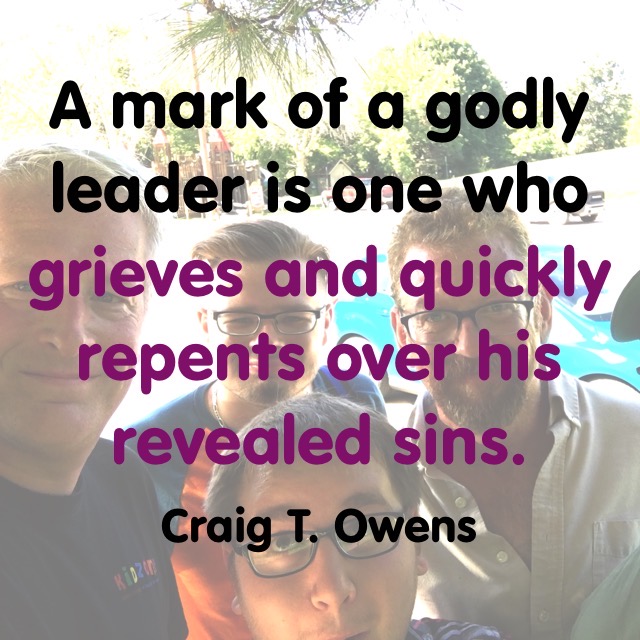
A mark of a godly leader is one who grieves and quickly repents over his revealed sins.
It starts at the top. It starts with me. Leaders must be held to the highest of standards.
I hope all godly leaders will join me in this prayer: Father God, may I be usable by You. May I be sensitive to the prompting of Your Holy Spirit, and grieve over my sins. May I be quick to repent and receive Your restoration, so that I can continue to lead other people into an intimate relationship with You.
This is part 62 in my series on godly leadership. You can check out all of my posts in this series by clicking here.
►► Would you please prayerfully consider supporting this ministry? My Patreon supporters get behind-the-scenes access to exclusive materials. ◀︎◀︎




 Craig T. Owens