A Word That’s Hard To Say

Listen to the podcast of this post by clicking on the player below, and you can also subscribe on AppleSpotify, or Audible.

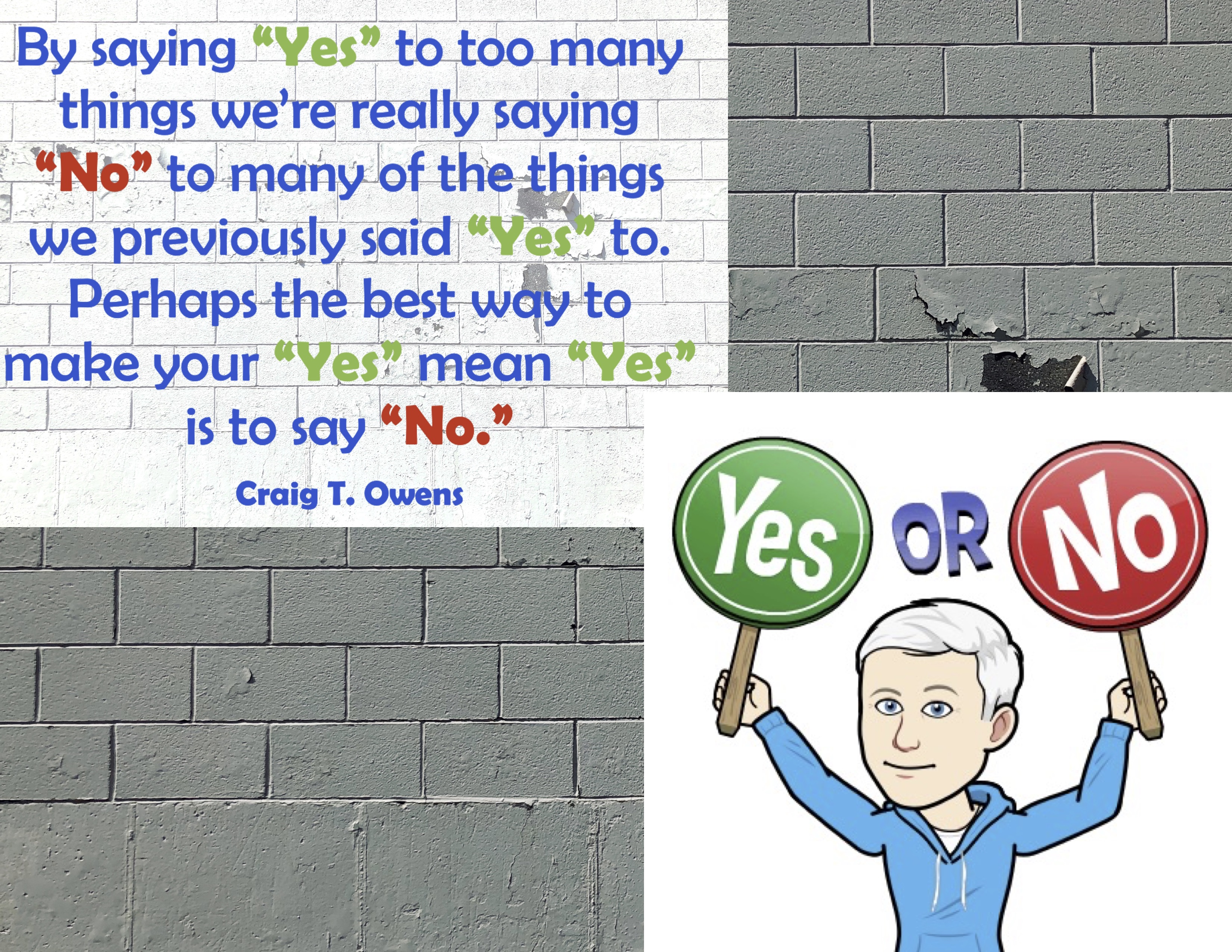
We all like “Yes.” That’s a nice word. But here’s the problem: By saying “Yes” to too many things we’re really saying “No” to many of the things we previously said “Yes” to.

Confused?

Let me try it this way. We all have only 24 hours in a day. No more; no less. We can all do a finite number of things during that 24-hour period. Some may be able to do slightly more, but even the most efficient people have a limit.

When we keep saying “Yes” over and over and over again, eventually our mouths are saying “Yes” but we cannot deliver. We’re out of time, out of resources, out of open places on our To Do list, out of patience, out of energy, out of money.

Perhaps the best way to make your “Yes” mean “Yes” is to say “No.” To truly evaluate what is important, how much time you have, or how much money you have. And then say “No” to the things that you cannot truly commit to.

It’s hard to say “No.” But saying “No” more often will make your “Yes” so much more doable. Otherwise, your verbal “Yes” becomes an “I’ll try,” which eventually is a “Not really,” which in reality is a “No” anyway. So just say “No” upfront.

     And don’t say anything you don’t mean. This counsel is embedded deep in our traditions. You only make things worse when you lay down a smoke screen of pious talk, saying, “I’ll pray for you,” and never doing it, or saying, “God be with you,” and not meaning it. You don’t make your words true by embellishing them with religious lace. In making your speech sound more religious, it becomes less true. Just say “yes” and “no.” When you manipulate words to get your own way, you go wrong. —Jesus (Matthew 5:33-37 in The Message paraphrase)

You can make your “Yes” so much more powerful by only saying “Yes” to those things that are truly important. That means you will need to get comfortable with saying a loving, but firm “No” more often than you probably have in the past.

How many different ways can you say it?

  • No
  • Nyet
  • Nein
  • Nee
  • Jo
  • He
  • Non
  • Δεν
  • לא
  • Nei
  • いいえ
  • Không
  • קיין

You may also want to check out a related post called Undecided Or Uncommitted?

►► Would you please prayerfully consider supporting this ministry? My Patreon supporters get behind-the-scenes access to exclusive materials. ◀︎◀︎
Tick, Tock! Drip, Drop!

Tick, Tock! “There just is never enough time in my day!”

Tick, Tock! “Wow, this day has just flown by and I got nothing done!”

Tick, Tock! “Why do I always have so much To Do List left at the end of my week?”

May I suggest that instead of Tick, Tock! you focus on Drip, Drop!

(The data compiling website Flowing Data has a fascinating look at how men and women of all ages spend their time throughout the day.)

I’ve gotten some great insight on time usage from Paul Meyer. Check it out:

“Most time is wasted, not in hours, but in minutes. A bucket with a small hole in the bottom gets just as empty as a bucket that is deliberately emptied.”

Usually our time doesn’t just Tick! by, it Drips! by. In other words, it’s really easy to spot the huge time-wasters; it’s much more difficult to find the time-leakers. But they can be found and plugged. Listen to more good advice from Dr. Meyer:

“Time is usually wasted in the same way every day.”

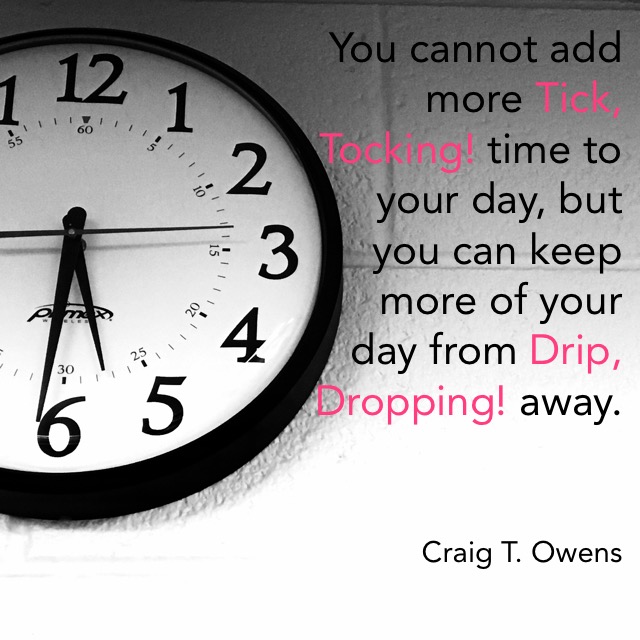
You cannot add more Tick, Tocking! time to your day, but you can keep more of your day from Drip, Dropping! away. Here are two things I’ve done which have really helped me:

  1. For one week (7 full days) I kept a log of how I spent every 15-minute increment. This might sound like a Drip, Drop! thing to do, but I was amazed at how many leaks I discovered after a week of doing this.
  2. Then I prayed the same prayer Moses prayed, “Give me wisdom to use my days the right way.”

If you can identify the time leaks, God can give you the wisdom to help you plug them. When you can control the Drip, Drop! you’ll get more out of your Tick, Tock! each day.

UPDATE: The thoughts in this chapter became a whole chapter in my book Shepherd Leadership. The chapter is called ‘Can’t, Won’t, or Don’t,’ and it addresses the three attitudes that hold us back from stewarding our time.

Managing “To Do” Lists

I’ll bet many of you have your “To Do” lists ready to go this week. I’ve got my list ready. But even as I was working on my list last night I knew that I probably wouldn’t be able to get everything done that I’m hoping to get done. Do you ever feel like that?

So how do you respond? Just doggedly press through no matter what? Let off the gas a little because you know it’s not all going to get done anyhow? Or just scrap the list and fly by the seat of your pants?

Here are 4 things I’ve learned (and I’m still learning) that might help you:

  • Begin the day with prayer. The Bible says that the steps of the righteous are directed by God. He knows what’s in store for you today and He can help guide you in your list-making time.
  • Know the difference between important and urgent. The urgent things always scream at you, while the important things usually stand by silently. Focus on what’s important. And here’s one key guideline: People are important.
  • Don’t try to get it all done today. I love John Maxwell’s reminder, “We overestimate what we can do in a day; we underestimate what we can do in a year.” If I only get time to read one chapter a day in a book, that’s still 365 chapters at the end of the year, and that’s quite a few books! It’s good to take a long-range view.
  • Look for the small time-wasters. If you just track one week’s time usage in 15-minute increments, you’ll be amazed to find out where a few minutes here and a few minutes there add up to a whole lot of time at the end of each week.

I’m still learning this stuff. If you have some tips or strategies that work for you, I’d love to hear them. Please share in the comment section.