Photo (c) Laura Kranz at The Overview Bible Project (click on the photo for more info)
The prophet Obadiah wrote just 21 verses around 840 B.C. I know that the last 12 books of the Old Testament are referred to as “minor prophets” (not because of quality or validity, but because of length), but this prophet packs a major punch. Here are three lessons I learned from Obadiah―
[1] Pride is a killer.
The pride of your heart has deceived you (v. 3). Pride makes me believe the best about myself and the worst about everyone else; it’s unbalanced scales. Pride allows me to excuse my sins, even calling them “virtues,” while at the same time hypocritically judging the “sins” of others.
[2] It is God’s place to judge, not mine.
You should not look down on your brother in the day of his misfortune (v. 12). My place is to love God and love others—to help and not condemn—to extend mercy, not judgment. Even if my enemy stumbles I shouldn’t rejoice or gloat (Proverbs 24:17-18), how much less when it’s my brother who has stumbled!
[3] Live as if Judgment Day were tomorrow.
The day of the Lord is near for all nations. As you have done, it will be done to you; your deeds will return upon your own head (v. 15). Boom! The measure I use will be the measure I receive. The One Who neither sleeps nor slumbers sees all I do, and He will judge perfectly.
Don’t miss the major messages in the “minor” prophets!
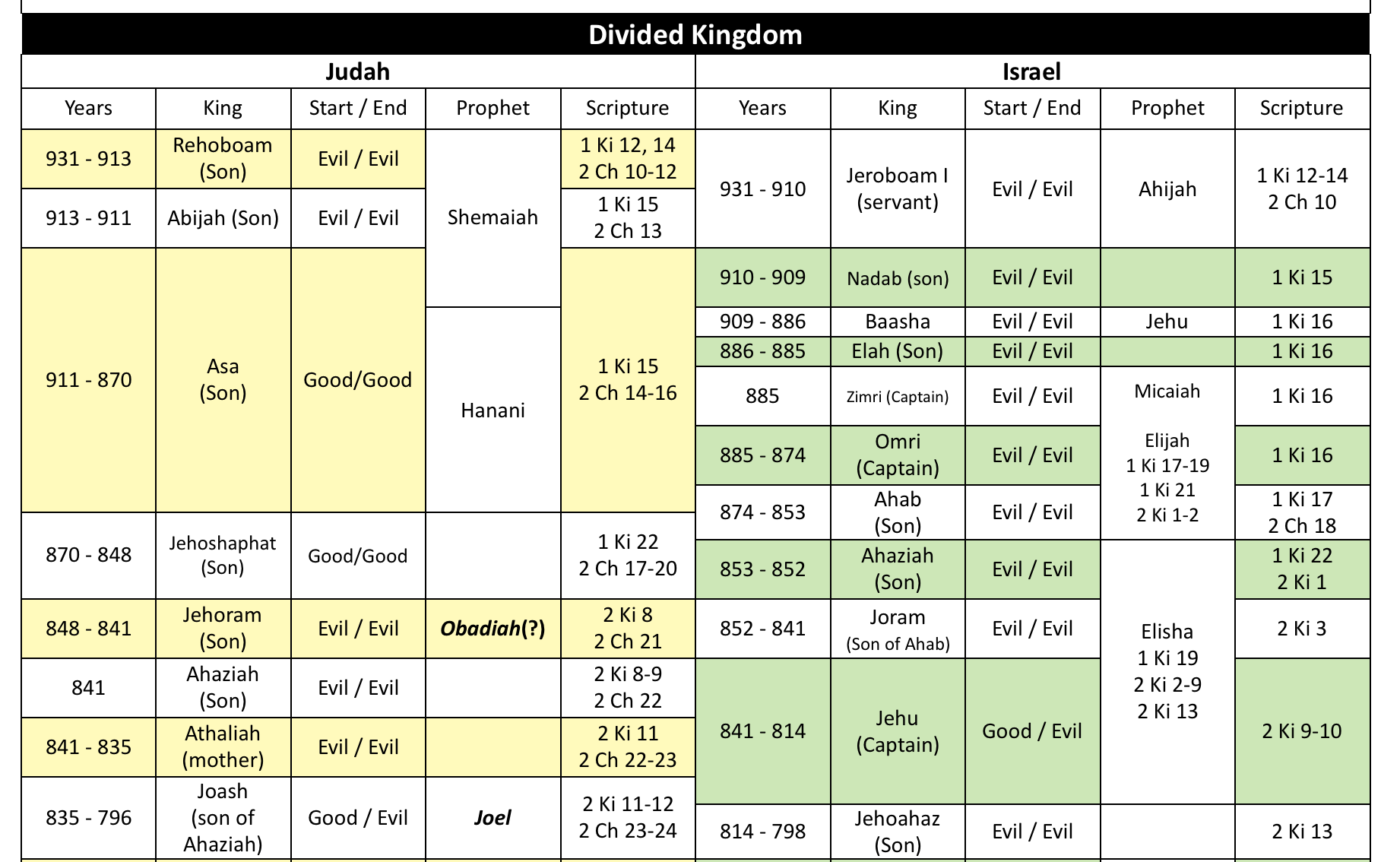
On the Biblegateway website, Jacob Edson has taken my chart and added even more details and cross-references to related Scriptures for each of the kings on this chart.
One challenging point in history is the divided kingdoms of Israel (the 10 northern tribes) and Judah (the 2 southern tribes). What makes it challenging when reading straight through the Bible is the history is covered in 1 and 2 Kings and then again in 1 and 2 Chronicles. In the midst of these kingdoms, several prophets are sent by God. Some of these prophets only have their words recorded in Kings or Chronicles, while others have their words recorded elsewhere in the Bible (usually the book name is the prophet’s name).
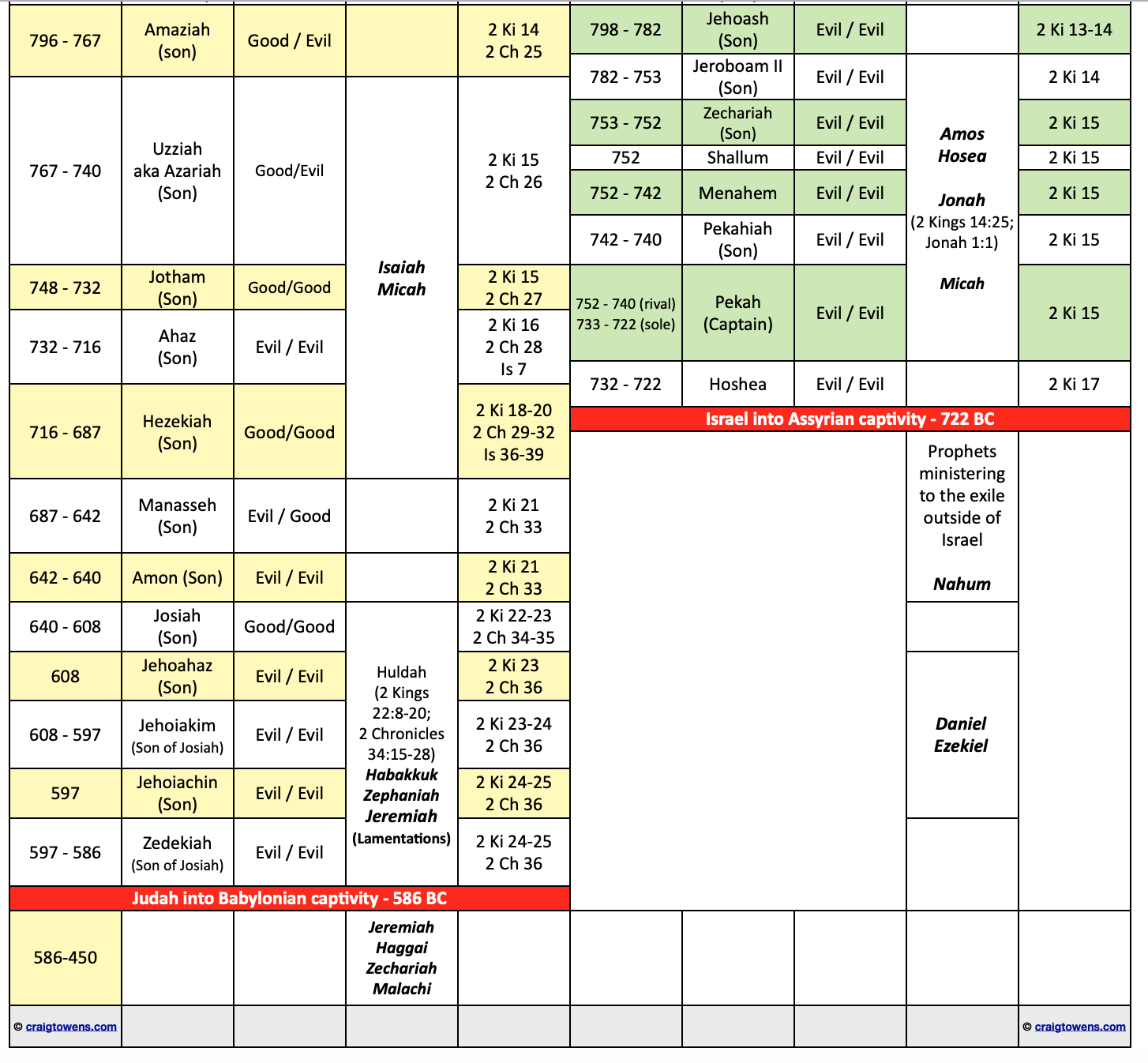
In trying to keep all of these people and messages clear in my mind, I have put together a list of all the kings and prophets during the period of the divided kingdom (roughly 931-586 BC).
You can click the picture above to get a larger view, or you can download a PDF copy by clicking here → Kings of Israel & Judah ←
I am not a biblical scholar, nor do I have a history degree. This is just a chart I put together to help me in my Bible reading, and I thought it might help someone else too. I would welcome any corrections or clarifications that anyone would offer on this humble work.
Not all of these updates are reflected in the screenshots on this page, but they are all in the PDF version.
**UPDATE 1: several people pointed out some tweaks I needed to make to this chart, and I am grateful for the input! This is the revised copy as of August 28, 2017.
**UPDATE #2: a few more tweaks … this is the revised version as of July 31, 2014.
**UPDATE #3: I have posted a chart zooming in on the chronology of the Old Testament prophets which I recreated from the Archeological Study Bible. You can read it and download it by clicking here.
A couple of notes:
Prophets who also have their words recorded in a book that bears their name are listed in bold italics.
The “start / finish” designation for each of the reign of the kings is clearly my subjective opinion.
Sometimes you will see dates for two kings’ reigns that overlap. These are where there was a co-regency (that is a father and son ruling simultaneously).
The prophets that are listed under the Israel side after Israel had gone into captivity are the prophets that God was using to speak to the Israelites in exile.
**UPDATE #4: I continue to do more research and get feedback from people far wiser than me. The latest version is dated August 28, 2017.
**UPDATE #5:The original chart stopped when Israel and Judah went into captivity. I have now added another line to show the prophets who continued to prophesy to both the exiles in Babylon, as well as to those who returned to Israel later.
**UPDATE #6: Scholars are unsure of the date of Obadiah. We know that it took place after invaders had caused problems in Judah (Obadiah 11)—and Edom responded in a way that angered God. Some scholars place this date after Nebuchadnezzar’s conquest of Judah in 586 BC, but since post-exilic prophets always named Nebuchadnezzar or Babylon, I think it’s more likely to have occurred during the reign of Jehoram around 840 BC (see also 2 Chronicles 21:8-10). Added Huldah as a prophetess during the reign of Judah’s King Josiah.
**UPDATE #7: Thanks to Anthony Wimmer, this chart is now available in French → Rois d’Israel & Juda
**UPDATE 8: I am always appreciative of the interaction with those who have downloaded my chart and are digging into the dates. After a few conversations, I have modified the chart slightly on the lower right quadrant of the last page to show those prophets who were ministering to the Israelites who were in captivity.
Even being “Boring” can make the message memorable!
God is Creator, which means His creativity knows no limits. One of the ways I love seeing His creativity on display is in the ways His love story is communicated to humanity. The prophets used some highly creative and sometimes startling ways to get God’s message across. But I especially like how Jesus communicated the message of the Kingdom of God to His audience.
He used…
Seeds and sheep
Farmers and friends who needed a late-night snack
Lost coins and lost sons
Grapes and goats
Pearls and prodigals
Stuffy judges and smart bride’s maids
Bridegrooms and buildings
Banquets and bread
Servants and silver coins
He told people who had gotten locked into an inaccurate interpretation of Scripture, “You have heard it said…but I tell you” just to get their attention.
These simple, everyday, common items reminded people of the eternal message. The objects didn’t become the message, but just a way to remind and reinforce the biblical truth Jesus was sharing.
That’s why I use poker chips … Lego pieces … plastic eggs … bookmarkers … flip-flop key chains … aluminum tabs from pop cans … glow sticks … and even name tags to creatively tell the Creator’s love story in a memorable way.
How are you using God’s creativity to tell His story?








 Craig T. Owens