Staggering Seduction

Listen to the podcast of this post by clicking on the player below, and you can also subscribe on AppleSpotify, or Audible. 

The northern tribes of Israel had been defeat by the Assyrians and gone into exile because of their persistent and unrelenting sins against God. You would think that this would be a vivid enough warning to get the attention of the people of Judah, but sadly it wasn’t. 

King Manasseh sinned and then doubled-down on his sinning. The prophets thundered their warnings, and Manasseh not only kept his sins going but he kept pulling more and more people down into sin with him. 

Isaiah pointed to the example of Israel’s sin—

     Woe to Samaria the crown of pride of the drunkards of Ephraim [the ten tribes], and to the fading flower of its glorious beauty, which is on the head of the rich valley of those overcome and smitten down with wine! … But even these reel from wine and stagger from strong drink: the priest and the prophet reel from strong drink; they are confused from wine, they stagger and are gone astray through strong drink; they err in vision, they stumble when pronouncing judgment. (Isaiah 28:1, 7 AMPC) 

Notice the words like reel and stagger, as though intoxicated by alcohol. 

A mark of an ungodly leader is one who is so intoxicated by his own power that he makes others drunk too. 

Look at this description of Manasseh: “But the people [of Judah] would not listen; and Manasseh seduced them to do more evil than the nations did whom the Lord destroyed before the Israelites!” (2 Kings 21:9). 

The Hebrew word translated “seduced” is the same Hebrew word that Isaiah used for the staggering and going astray of a drunkard. 

This is the power that leaders have for both good and evil. A sober-minded, godly leader can encourage people toward righteousness, but an ungodly leader who is intoxicated by his power seduces people to join him in his unrighteousness. Manasseh was described as “making Judah sin, by doing evil in the sight of the Lord” (v. 16).

Certainly there are people who choose a sinful lifestyle during the tenure of a godly leader, and there are people who steadfastly choose righteousness during the tenure of an ungodly leader. But the Bible issues strong warnings to those leaders who misuse their God-appointed positions of leadership to lead people astray (see Ezekiel 3:17-21, 33:1-9). 

Leaders, be on guard that a position of leadership doesn’t seduce you to stray from righteousness. Don’t forget that God chose you for this role, so to Him you will have to stand to give an accounting of your leadership. I pray you can say that you soberly and sincerely pursued righteousness and led your people in that pursuit as well. I want you to hear, “Well done, good and faithful servant” and not, “Depart from Me.” 

This is part 86 in my series on godly leadership. You can check out all of my posts in this series by clicking here.

►► Would you please prayerfully consider supporting this ministry? My Patreon supporters get behind-the-scenes access to exclusive materials. ◀︎◀︎

Set Up For Success (Or Failure)

Listen to the podcast of this post by clicking on the player below, and you can also subscribe on AppleSpotify, or Audible. 

Like it or not, your example as a leader is making an impact on all the people around you—including the next generation of leaders who will take their positions after you have passed away. 

So I have a simple question for you: Are you setting them up for success or failure? 

There is no middle ground. 

Consider three generation of kings of Judah—Hezekiah, Manasseh, and Amon. 

Hezekiah had been sick and God miraculously healed him. When Merodach-baladan, king of Babylon, heard about this, he sent envoys to see King Hezekiah. Instead of bragging on God, Hezekiah bragged about all of his riches. 

After the envoys left, the prophet Isaiah told Hezekiah the consequences of his pride

“Behold, the days are coming when everything that is in your house, and what your fathers have stored up to this day, will be carried to Babylon; nothing will be left,” says the Lord. “And some of your sons who will come from you, whom you will father, will be taken away, and they will become eunuchs in the palace of the king of Babylon.” (Isaiah 39:6-7) 

Sadly, Hezekiah responded, “At least it won’t impact me.” 

A mark of a godly leader is one who desires to set up future leaders for success. 

His son Manasseh became one of the most evil, godless kings that Judah had ever known. And as a result, he experienced the punishment that Isaiah had prophesied. 

Thankfully, Manasseh eventually humbled himself, repented of his sin, and got to experience God’s restoration to a small degree—

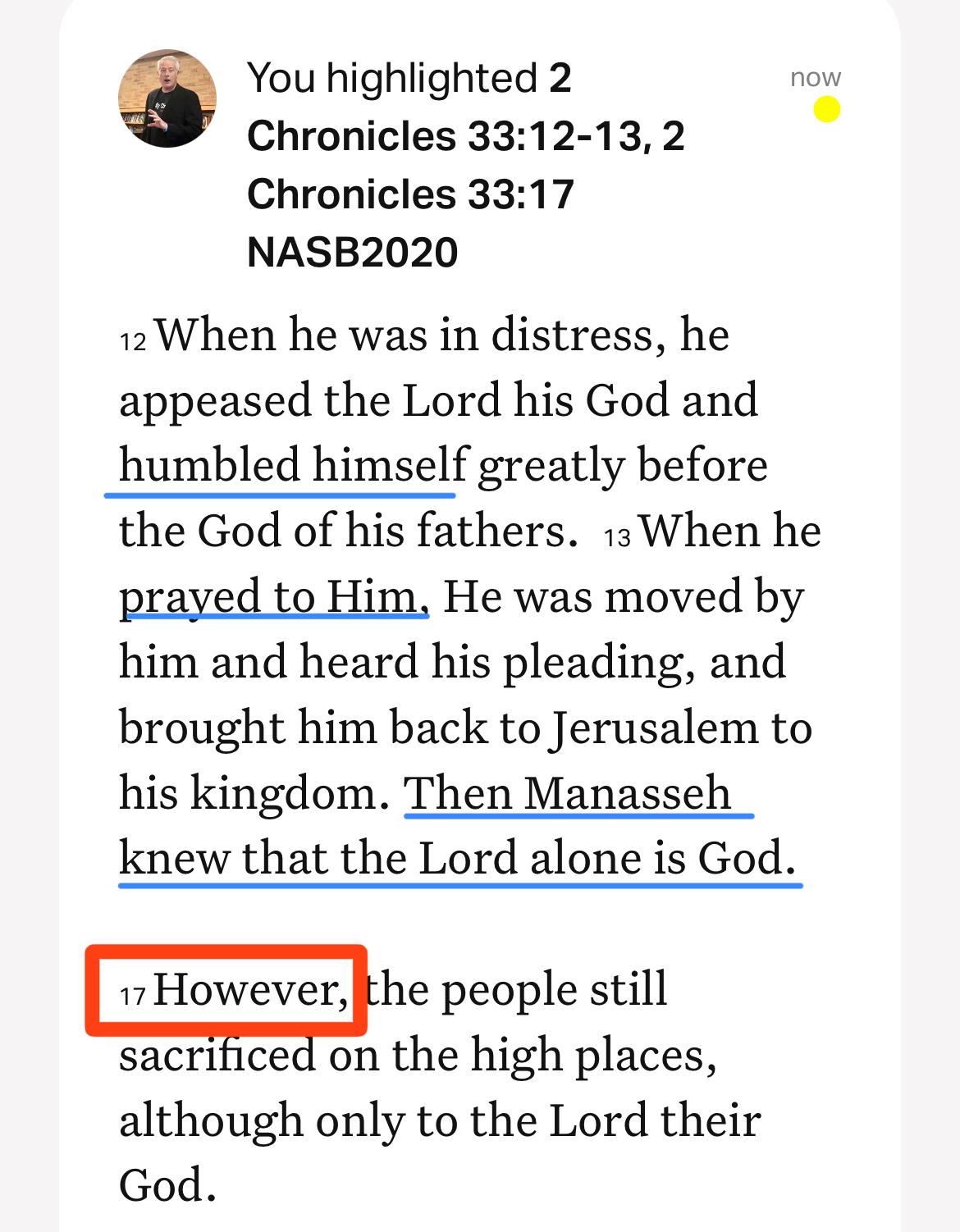
When he was in distress, he appeased the Lord his God and humbled himself greatly before the God of his fathers. When he prayed to Him, He was moved by him and heard his pleading, and brought him back to Jerusalem to his kingdom. Then Manasseh knew that the Lord alone is God. (2 Chronicles 33:12-13) 

But there is a sad “however” for Manasseh’s son Amon: However, the people still sacrificed on the high places (2 Chronicles 33:17). This mixing of the worship of God with the worship of pagan idols always pulls people away from God. It certainly did that for Amon because “he did evil in the sight of the Lord, just as his father Manasseh had done. For he walked entirely in the way that his father had walked, and served the idols that his father had served, and worshiped them” (2 Kings 21:20-21). “Furthermore, he did not humble himself before the Lord as his father Manasseh had done, but Amon multiplied his guilt” (2 Chronicles 33:23). 

Godly leaders should be just as concerned about the people that come after them as they are about the people around them now. Godly leaders strive to set up future generations for success—so they can receive God’s continued and increased blessings.

This is part 78 in my series on godly leadership. You can check out all of my posts in this series by clicking here.

►► Would you please prayerfully consider supporting this ministry? My Patreon supporters get behind-the-scenes access to exclusive materials. ◀︎◀︎
Consequences

It was a beautiful sunny evening. All of my work was done, Betsy was home from school, our cooler was packed, and we were off to the park. We were all looking forward to spend this lovely evening grilling some hotdogs, splashing in the water, enjoying the breeze off the lake, and just spending time as a family.

But like an unexpected rear-end collision, all our plans for a fun evening were smashed in a single moment. As we were carrying our cooler and towels and toys toward the picnic tables, a couple of my kids acted up… they broke some of our family no-no’s.

Their actions took less than two seconds. It was just between two of them. But the entire family was affected. We turned around and headed home. No hotdogs on the open grill, no beach time, no after-dinner walk on the trails.

Two made a mistake, but all suffered because actions have consequences.

Isaac Newton said for every action there is an equal and opposite reaction. We often think of this when, for instance, in a game of billiards the cue ball hits another ball. The energy from the cue ball is transferred to the other ball, moving it in the direction it was struck. Sometimes we might be tempted to believe that the only two balls affected were the cue ball and the ball that was struck. But that is not correct. Since those two balls have now been moved to another position on the table, their new positions now affected the entire table—the entire game is now different because of action and reaction.

There are consequences for our actions. And almost always those consequences are felt by someone other than the one who acted. Sometimes the consequences are pleasant and sometimes they are painful or even disastrous.

In Old Testament history, we see good consequences. King David was a righteous man, one who loved God and obeyed God’s commands. About 300 years later King Hezekiah sat on the same throne of Israel. When the Assyrian army was headed toward Jerusalem, Hezekiah prayed and asked for God’s help. God responded, “I promise that the king of Assyria won’t get into Jerusalem, or shoot an arrow into the city, or even surround it and prepare to attack. … I will protect it for Myself and for My servant David.

And we see bad consequences. There was a wicked king of Judah named Manasseh. He is not only one of Judah’s longest-reigning kings, but he is also widely regarded as Judah’s most wicked king. Yet in his lifetime, his kingdom seemed to prosper. And even though his grandson Josiah turned away from evil and turned toward God like no other king ever had done before, just four years after his death Jerusalem fell. King Jehoiachin was defeated and all of Judah was carried off into exile by Nebuchadnezzar as a consequence of Manasseh’s sinful behavior.

Our kids that acted up wrote notes of apology which they read to the family (as we ate our hotdogs at home) and we all forgave them. And we had a nice evening playing around the house. But the evening still had the tinge of regret for what could have been.

Our choices today will have consequences tomorrow. Our actions always affect more than just ourselves—they affect everyone close to us. The people in Hezekiah’s day were grateful for the blessed consequences of David’s right choices. The people in Jehoiachin’s day were grieved for the disastrous consequences of Manasseh’s wrong choices.

What about you? What will your descendants feel about the consequences they are experiencing because of your choices today? It’s up to you, and it’s for them, so live right today.