Once a friend of mine (whom I happen to think is more tuned-in to people’s needs than almost anyone else I know) went on a first date. He said the evening was pleasant, but felt his date was a bit distant. At the end of the evening when he brought up the subject of possibly going out again she informed him, “No, I don’t think we can go out again. You’re just not emotionally available for me.”
I know this wasn’t true for my friend, but have you ever been there? Ever been with someone, but it was obvious that they weren’t really there with you in the room? Frustrating, isn’t it?
[Insert tongue firmly in cheek as you read this next paragraph.] Now I’m certain that none of the readers of my blog would ever be distracted like this. And I know I’ve never done this myself. Since you and I, dear reader, always are 100% attentive to the people in the room with us, these next two quotes probably won’t pertain to you, but here they are anyhow:
 “The human brain is simply not designed to multitask. You can get by doing multiple things at once, but you can’t do them well. Your brain is physically unable to process more than one set of instructions at a time, so while you are juggling all of those actions at once, your brain is scrambling to keep up. Through a variety of experiments measuring brain activity, scientists have discovered that the constant switching back and forth from one activity to another energizes regions of the brain that specialize in visual processing and physical coordination, while simultaneously disrupting the brain regions related to memory and learning. According to the research, ‘we are using our mental energy to concentrate on concentrating at the expense of whatever it is that we’re supposed to be concentrating on.’ Got that?
“More simply: when we multitask we’re dumber. How much dumber? A recent study for Hewlett Packard exploring the impact of multitasking on performance revealed that the average worker’s functioning IQ drops ten points when multitasking…. (The analogy the researchers used is that a ten-point drop in IQ is equivalent to missing one night of sleep.)” —Marcus Buckingham, Find Your Strongest Life
 “Concentration, which leads to meditation and contemplation, is therefore the necessary precondition for true hospitality. When our souls are restless, when we are driven by thousands of different and often conflicting stimuli, when we are always ‘over there’ between people, ideas and the worries of this world, how can we possibly create the room and space where someone else can enter freely without feeling himself an unlawful intruder?” —Henri Nouwen, The Wounded Healer
This week I’m making it my goal to be all there for whomever is here with me. I’m going to try my best to eliminate multitasking and truly concentrate on the one spending time with me. Are you ready to try this with me? Let me know how it goes.



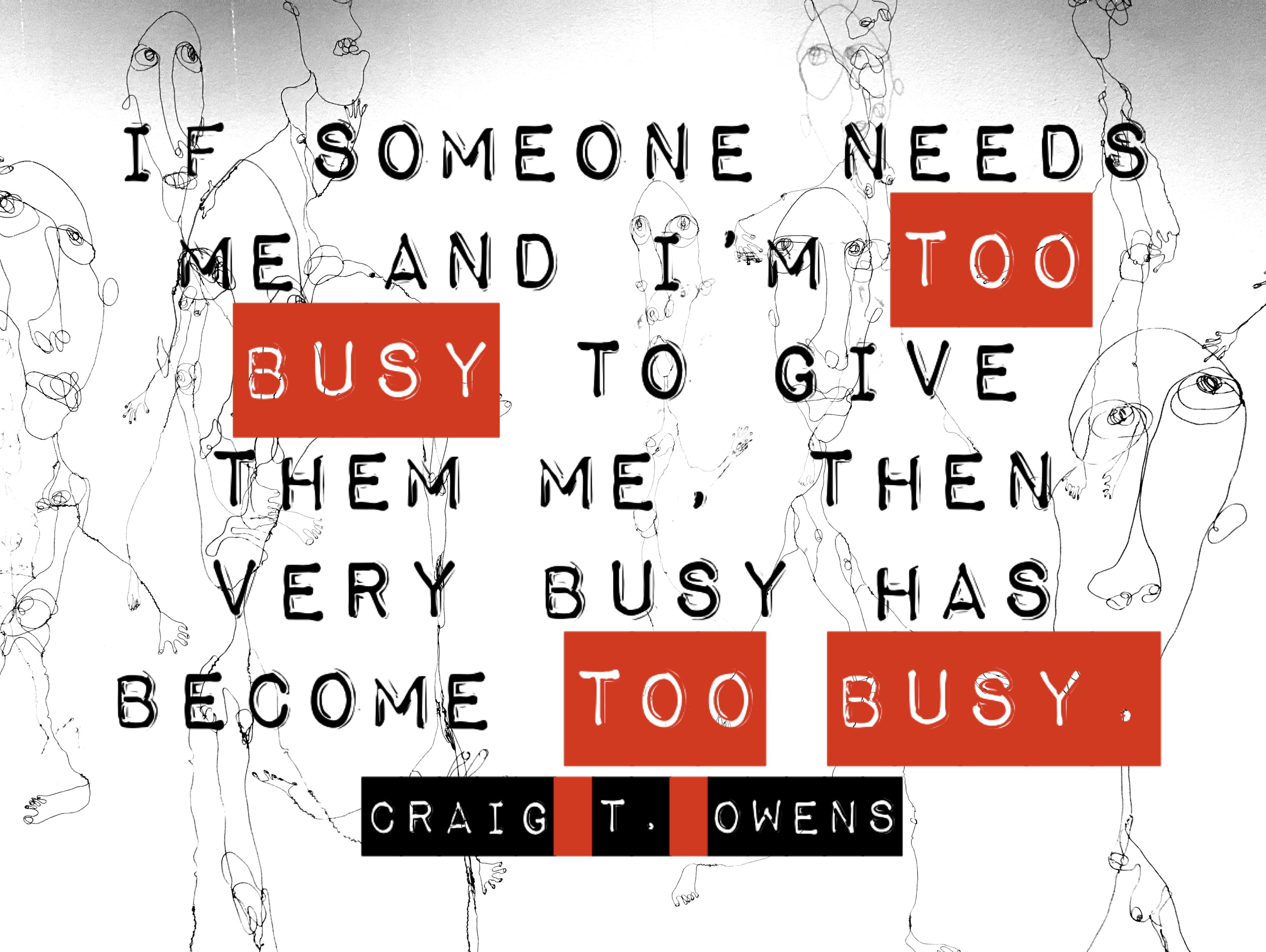 Over the last couple of weeks, I’ve been extremely busy. In some ways that’s a good thing: ministry is happening, relationships are developing, business is taking place.





 Craig T. Owens