



click for larger view
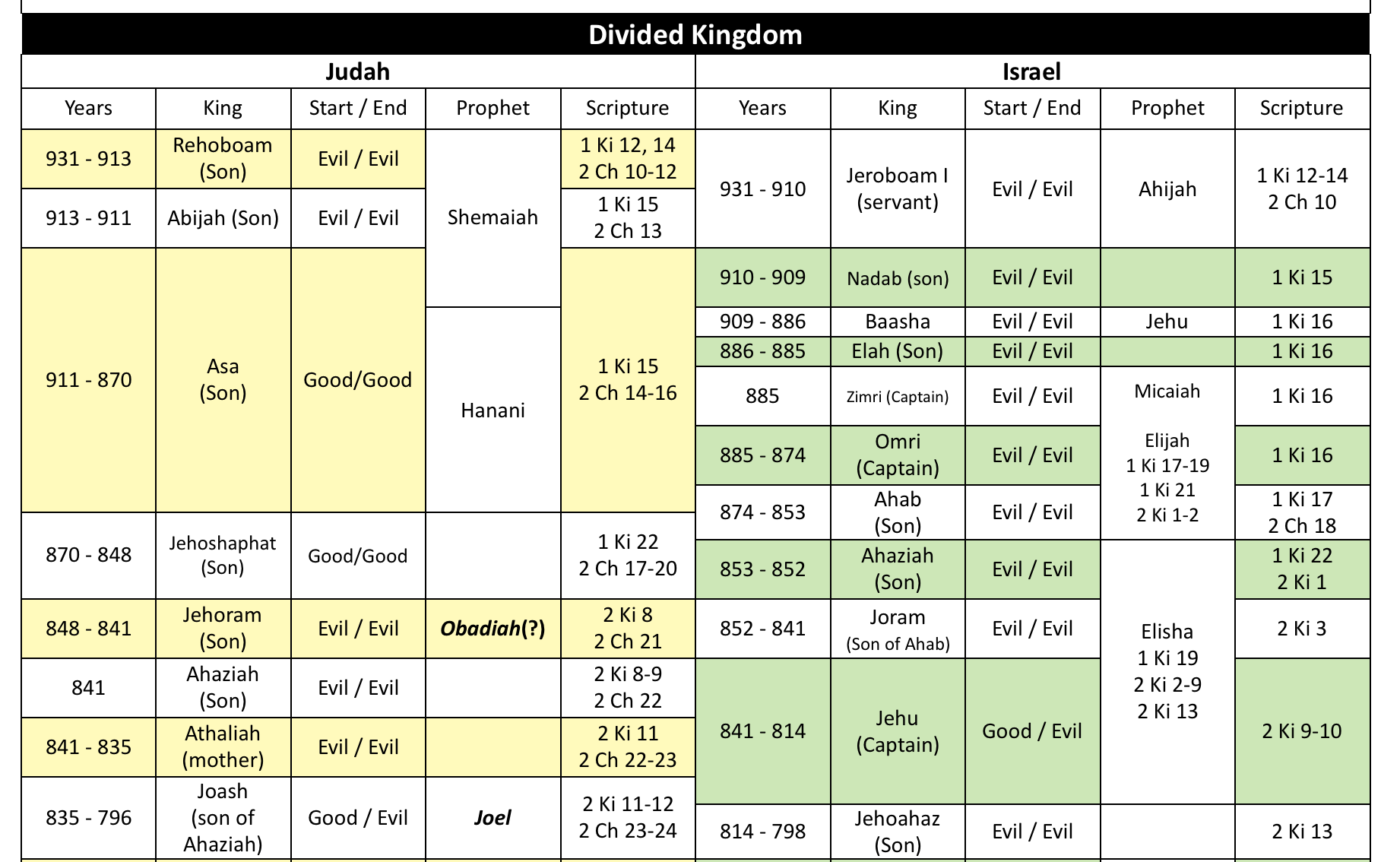
click for larger view
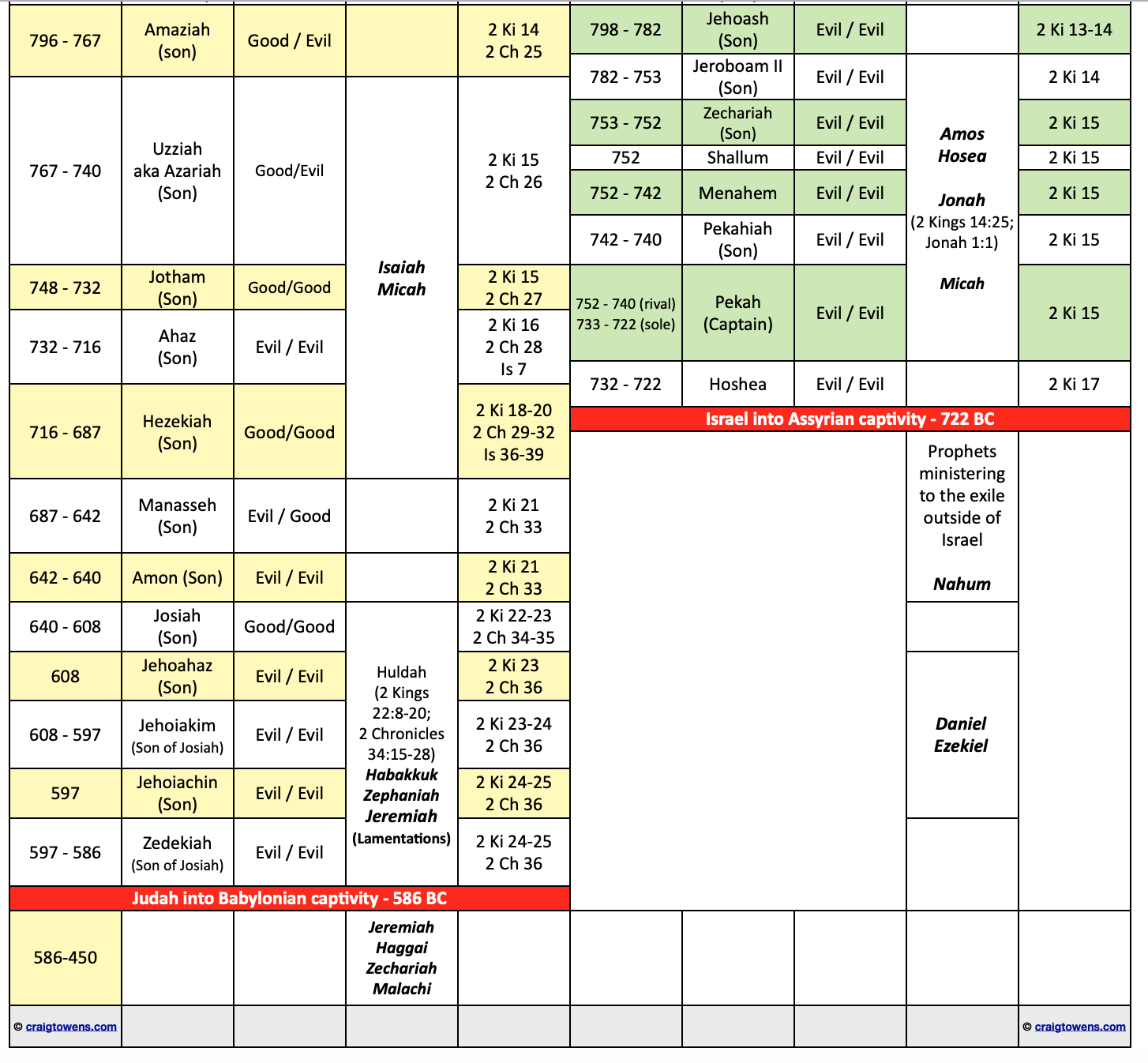
click for larger view
I posted earlier that I am reading through my Archeological Study Bible in chronological order. In other words, I’m reading the books of the Bible not in the order they appear, but in order of the historic events they cover.
On the Biblegateway website, Jacob Edson has taken my chart and added even more details and cross-references to related Scriptures for each of the kings on this chart.
One challenging point in history is the divided kingdoms of Israel (the 10 northern tribes) and Judah (the 2 southern tribes). What makes it challenging when reading straight through the Bible is the history is covered in 1 and 2 Kings and then again in 1 and 2 Chronicles. In the midst of these kingdoms, several prophets are sent by God. Some of these prophets only have their words recorded in Kings or Chronicles, while others have their words recorded elsewhere in the Bible (usually the book name is the prophet’s name).
In trying to keep all of these people and messages clear in my mind, I have put together a list of all the kings and prophets during the period of the divided kingdom (roughly 931-586 BC).
You can click the picture above to get a larger view, or you can download a PDF copy by clicking here → Kings of Israel & Judah ←
I am not a biblical scholar, nor do I have a history degree. This is just a chart I put together to help me in my Bible reading, and I thought it might help someone else too. I would welcome any corrections or clarifications that anyone would offer on this humble work.
Not all of these updates are reflected in the screenshots on this page, but they are all in the PDF version.
**UPDATE 1: several people pointed out some tweaks I needed to make to this chart, and I am grateful for the input! This is the revised copy as of August 28, 2017.
**UPDATE #2: a few more tweaks … this is the revised version as of July 31, 2014.
**UPDATE #3: I have posted a chart zooming in on the chronology of the Old Testament prophets which I recreated from the Archeological Study Bible. You can read it and download it by clicking here.
A couple of notes:
-
- Prophets who also have their words recorded in a book that bears their name are listed in bold italics.
- The “start / finish” designation for each of the reign of the kings is clearly my subjective opinion.
- Sometimes you will see dates for two kings’ reigns that overlap. These are where there was a co-regency (that is a father and son ruling simultaneously).
- The prophets that are listed under the Israel side after Israel had gone into captivity are the prophets that God was using to speak to the Israelites in exile.
**UPDATE #4: I continue to do more research and get feedback from people far wiser than me. The latest version is dated August 28, 2017.
**UPDATE #5: The original chart stopped when Israel and Judah went into captivity. I have now added another line to show the prophets who continued to prophesy to both the exiles in Babylon, as well as to those who returned to Israel later.
**UPDATE #6: Scholars are unsure of the date of Obadiah. We know that it took place after invaders had caused problems in Judah (Obadiah 11)—and Edom responded in a way that angered God. Some scholars place this date after Nebuchadnezzar’s conquest of Judah in 586 BC, but since post-exilic prophets always named Nebuchadnezzar or Babylon, I think it’s more likely to have occurred during the reign of Jehoram around 840 BC (see also 2 Chronicles 21:8-10). Added Huldah as a prophetess during the reign of Judah’s King Josiah.
**UPDATE #7: Thanks to Anthony Wimmer, this chart is now available in French → Rois d’Israel & Juda
**UPDATE 8: I am always appreciative of the interaction with those who have downloaded my chart and are digging into the dates. After a few conversations, I have modified the chart slightly on the lower right quadrant of the last page to show those prophets who were ministering to the Israelites who were in captivity.


 Craig T. Owens
August 11, 2014 at 1:03 pm
[…] Blogger Grid member Craig T. Owens (@craigtowens) has created the helpful chart above delineating the Old Testament kings and prophets of Israel and Judah. He says: […]
LikeLike
April 25, 2021 at 2:49 pm
Thank you for your work and insight: excellent chart! Might I also request an excel version via email for use in our classical Christian academy class? Again, Thank Your for your service!
LikeLike
April 25, 2021 at 6:48 pm
Brent, I am emailing you an Excel version of this chart right now.
LikeLike
May 31, 2022 at 10:39 am
I am interested in also receiving an excel version of this chart.
LikeLike
May 31, 2022 at 11:03 am
Kari, I just emailed this to you. Thanks for asking!
LikeLike
November 16, 2023 at 11:11 am
Craig, this chart is exactly what I needed to organize my thinking. I would love an excel version to supplement my women’s Bible study of the minor prophets. Thanks for doing this and your willingness to share.
LikeLiked by 1 person
September 16, 2024 at 9:16 am
Hello, Craig.
Love your charts and so glad to have found them. I did this years ago but lost track of the chart in my missionary travels. Thanks for your hard work.
LikeLiked by 1 person
September 16, 2024 at 11:17 am
My pleasure! Glad it’s helpful for you.
LikeLike
August 11, 2014 at 2:20 pm
I’m glad you did this; i was trying to come up with a visual for this after reading these books for the 2nd and 3rd times.
LikeLike
August 11, 2014 at 2:39 pm
My pleasure! It’s definitely a lot easier for me to re-read these histories with a resource like this. Hope it helps you, too.
LikeLike
September 8, 2019 at 4:18 pm
Hi Craig. Blue Letter Bible has a Chronological Bible-in-a-year reading plan which would be a great third source for matching up kings and prophets. You get all of the prophets prophesying to all of the kings in their historical order. For instance, this week I will be reading [in order] 2 Kings 12-13, 2 Chronicles 24, 2 Kings 14, 2 Chronicles 25, Jonah, 2 Kings 15, 2 Chronicles 26, Isaiah 1-8, Amos, 2 Chronicles 27, Isaiah 9-12 …
LikeLike
September 9, 2019 at 6:09 am
I love the resources at BLB. Do you have their app for your mobile device too? I pull this one up on my phone quite often.
LikeLike
April 28, 2016 at 9:59 pm
Hi Craig – thank you for all the work you did on this. A chart like this is surprisingly hard to find. I am co-teaching a “big picture” class on the entire bible at my church. Would you be willing to let me have a copy of the Word or Excel file you did this in originally? I want to present this but slightly modified by adding the core message of each prophet to his audience. I would of course share with you what I come up with and give credit where credit is due. If you’d rather not that’s fine also – thanks again for the valuable resource!
LikeLiked by 1 person
April 29, 2016 at 6:54 am
Shane, I am so honored that you would want to use these materials to teach others! I will email a copy to you today. Blessings!
LikeLike
June 8, 2016 at 6:47 pm
hey love it…using it in teaching through the story of the bible!
LikeLiked by 1 person
June 8, 2016 at 8:23 pm
So cool, Bruce! Thanks for letting em know.
LikeLike
January 4, 2017 at 1:33 am
(Joel 800-500 BC)!???
LikeLike
January 6, 2017 at 3:52 pm
Davar, thanks for bringing up this point. The “c.” in dating is the abbreviation for the Latin word “circa” which means “about” or “around.” Quite simply, Joel doesn’t give us explicit information to help us date his work. The Archeological Study Bible (an excellent resource for Bible study, by the way) says this about the date of the Book of Joel—
“The book of Joel itself gives no indication of its date of authorship. This is unusual in the Old Testament prophetic literature; most prophets indicated that they preached during the reigns of certain kings (e.g., Hos 1:1; Hag 1:1) or provided other chronological indicators (Am 1:1). The dates suggested for Joel range from the ninth century B.C. (making him the earliest of the writing prophets) to the late postexilic period (making him one of the latest). The following arguments are often raised in the discussion:
—Joel is the second of the minor prophets, and thus the book is early, since they are roughly presented in chronological order. But there are exceptions to this rule: Obadiah, for example, almost certainly was written later than Micah, and Hosea later than Amos.
—No kings are mentioned, and therefore the book is postexilic. On the other hand, postexilic prophets sometimes dated their books by Persian kings (Hag 1:1; Zec 1:1). Thus, the non-mention of any king does not imply anything in particular about the book’s date.
—Joel does mention priests and elders, and therefore the book was written when the nation was governed by these groups rather than by a king, making the book postexilic. However, the elders are mentioned only in a context of calling for ritual lamentation (2:15–17). They are not said to have been in a governing position, and the reference may in fact have been literally to a group of elderly men (1:2). Again, nothing here helps us to date the book.
—Joel never alludes in any way to the northern kingdom (usually called Israel or Samaria), suggesting that the northern kingdom may no longer have existed and that the book was thus written after the fall of Samaria (722 B.C.)
—Jerusalem had walls (2:7–9). Thus, the book was written either before its fall (586 B.C.) or late in the postexilic period, after the walls had been restored.
—Worship was carried out at the temple (2:15–17), indicating that the book was written either before its destruction or after its restoration.
—All who lived in the land could gather in Jerusalem (1:14). This suggests that the population of the community was relatively small, as in the late preexilic or the postexilic period.
A few other fine points regarding the language and circumstances of Joel are debated but have produced no consensus.
All in all, the above considerations speak against a date that was very early, very late or during the exile. Apparently the northern kingdom no longer existed, but the temple was functioning and Jerusalem’s walls were intact. A seventh-century B.C. date seems reasonable, but the fact remains that the book itself does not tell us when it was written.”
Hope this helps clear things up a bit!
LikeLike
July 21, 2017 at 5:53 pm
Just discovered this fantastic resource today via Bible Gateway…something I’ve been searching for “forever.” I’d like an Excel version for my own study and notes, adding some “what was gong on in the rest of the world” information for my own reference.
LikeLike
July 21, 2017 at 7:09 pm
I will work on getting an Excel version to you in short order.
LikeLike
August 20, 2019 at 1:19 am
Hello Can I get an excel as well please of this chart? It’s very well built. Thanks
LikeLike
August 20, 2019 at 2:32 pm
David, I just emailed this to you.
LikeLike
September 5, 2017 at 8:40 am
Thank you so much, Craig Owens, for putting this together and making it available to others here for free. I am studying to prepare to give a talk on the prophets Amos and Isaiah, as we are starting a Community Bible Study year on these two prophets. Your charts help enormously and I will look at buying “The Archeological Bible” thanks to you.
LikeLike
September 5, 2017 at 9:01 am
Connie, I sure do appreciate you sharing this with me. If you enjoy Bible history, I am sure you will enjoy that Archeological Study Bible. I am believing with you that your Bible study on Amos and Isaiah will be life-changing for those involved.
LikeLike
April 11, 2018 at 6:04 am
[…] Israel (the 10 northern tribes) was in the final stages of collapse, with kings only serving short spans, idolatry running rampant, and enemies closing in on every side. Isaiah boldly proclaimed that Judah was on the same path unless she repented and turned wholly to God. […]
LikeLike
June 15, 2018 at 9:50 pm
Your’e a good man Craig. Thanks for your help.
Rob
LikeLiked by 1 person
June 15, 2018 at 10:01 pm
My pleasure!
LikeLike
November 12, 2018 at 3:51 pm
I’m teaching a Bible class tomorrow and we’ll be doing a survey of the Divided Kingdom. Can I have your permission to run off 10 copies for my class (full credit will be given profusely!)
LikeLiked by 1 person
November 12, 2018 at 3:59 pm
Yes! I’m so honored that you will be using this material.
LikeLike
January 7, 2019 at 4:58 am
Thank you for posting this. I also started a chart like this but took it all the way back to Adam
I have a non critical question.
2 Kings 15:1 says Uzziah reigned in Jerusalem fifty-two years. You have him reigning 767-740. 27 years.
His son Jotham you have overlapping him 748-732.
LikeLike
January 10, 2019 at 6:57 pm
Good catch, Michael. There are some difficulties with dates, especially here because of the king’s leprosy and his son serving as co-regent.
The Archeological Study Bible also wrestles with this difficulty of dating by offering this comment—
“Jotham of Judah, son and successor to Uzziah, was for sometime cold-regent with his father (2 Kings 15:5). The chronology of his reign is difficult to sort out, as the Biblical synchronisms are not coherent. For example, verse 32 states that Jotham reigned 16 years, whereas verse 30 states that Hoshea of Israel began to reign during Jotham’s twentieth year. It may be that the sixteenth year of Jotham’s reign began in 750 B.C., when he was co-regent with Uzziah, and extended to about 735. He they have remained alive for another few years while his son Ahaz was effectively king, thus allowing the Bible to speak of Jotham’s ‘twentieth year.’”
Does that help a bit?
LikeLike
January 11, 2019 at 2:10 am
I also came to the conclusion that as long as it was there and thereabouts what does it matter. I’m sure I read a scripture somewhere warning about getting sidetracked out of the Bible. If I was a teacher no doubt I’d have chapter and verse. The history buffs seem to be pretty definite about the exile dates and so having got there we go back up the making adjustments. Then they seem pretty definite about King David dates so we come down making adjustments and around about Uzziah they mismatch. I just split the difference.
The important point for me is to have the background of the prophets so as to understand what God is talking about. I discovered that after I made my chart the Holy Spirit started explaining the Bible to me as I read it and then reading the Bible becomes very interesting indeed. The warnings they received then apply to us right now I think.
I like your Blog comments btw. The world is a battleground indeed.
LikeLiked by 1 person
September 7, 2019 at 9:56 am
I’m simply a homeschooling mom leading her daughter through World History and Biblical history. We will learn together. Thanks for this information!
LikeLiked by 1 person
September 7, 2019 at 10:11 am
Wow, thank you for sharing with me. And I’m glad you’re learning together 😀
LikeLike
September 9, 2019 at 6:03 am
[…] minor prophets cover a span of about 300 years, from 760 BC (Amos) to 450 BC (Malachi). You can check out this side-by-side chart to see where these prophets fit in the history of Judah and […]
LikeLike
November 23, 2019 at 8:08 pm
Thank you. Your chart is very helpful. I would like permission to copy this chart and use it with our adult Bible fellowship group. I appreciate having so much information in one chart, including scripture passages, and prophets. Adding the good/bad for the beginning and end is also helpful.
LikeLike
November 23, 2019 at 8:29 pm
I’m so glad you like it. Yes, you may use it but please don’t remove the craigtowens.com designation at the bottom. If you would like the chart in another format, simply send me your email address and let me know what format you’d like.
LikeLike
June 9, 2020 at 3:30 am
The chart is great – can I use it, please – and I will happily attribute it to you…
LikeLike
June 9, 2020 at 5:25 am
Yes, please do. I’m glad you like it 😀
LikeLike
August 22, 2020 at 7:08 pm
Thank you. I am reading through Bible in One year and getting bamboozled about all the Kings, good and bad and good/ bad so I went looking for something that would unbamboozle me. Thank you so much. This is a great help.
LikeLiked by 1 person
August 22, 2020 at 7:12 pm
Thank you for letting me know!
LikeLike
August 26, 2020 at 11:45 am
[…] been reading through the soap opera history of the kings of Israel and Judah. Like our modern soap operas there are three types of kings: (a) the good kings did what was right […]
LikeLike
September 14, 2020 at 6:02 am
[…] The minor prophets cover a span of about 300 years, from 760-450 BC, and Jonah appears right in the middle of that. Jonah overlaps Amos and Hosea in northern Israel, and he finishes his ministry just before Isaiah’s ministry begins in northern Judah. […]
LikeLike
September 16, 2020 at 1:11 pm
[…] You may also want to check out my chart of the kings and prophets of the divided kingdom of Judah and Israel. […]
LikeLike
September 29, 2020 at 12:03 pm
Craig, this is an incredible resource! I have been teaching about the dynasty of kings in my adult Sunday School class and this would be a tremendous help. May I please have an Excel copy as well? There are a few things I would highlight for our senior students to make it easier for them to read. Thank you for your work you are doing!
Pastor Ron
LikeLiked by 1 person
September 29, 2020 at 12:21 pm
Thank you, Ron, for your nice comments. I would be happy to send this to you in an Excel format. Can you give me an email address?
LikeLike
September 29, 2020 at 12:57 pm
rwhited001@gmail.com
Thank you!!
LikeLike
October 5, 2020 at 6:02 am
[…] Micah introduces himself in the opening verse. He was ministering in the country while Isaiah was in…. […]
LikeLike
October 14, 2020 at 6:01 am
[…] I am intrigued by the succession of the last kings of Judah just before Jerusalem falls in 586 BC. The leadership authority has been completely undermined by the downward spiral of sin in the previous leaders. As a result, the kings of Judah are now just an “empty suit,” with someone else exerting the real influence. […]
LikeLike
February 11, 2021 at 6:25 am
[…] Owens, C. T. (2014, July 16). Israel’s kings and prophets [web blog post]. Retrieved from https://craigtowens.com/2014/07/16/israels-kings-prophets/ […]
LikeLike
May 27, 2021 at 7:54 pm
[…] In the Old Testament, there’s a phrase the repeats at the end of the historical record of almost every king of Israel and Judah: […]
LikeLike
July 12, 2021 at 12:13 pm
[…] Israel’s early history goes something like this: King David firmly established Israel’s boundaries, King Solomon built on David’s success, then King Rehoboam split the country in half. […]
LikeLike
July 15, 2021 at 6:07 pm
[…] been studying the lives of the kings of Judah. The last God-fearing king before the fall of Jerusalem was a man named Josiah. He became king as […]
LikeLike
August 28, 2021 at 4:39 am
Hello there.
Happened to find this ressource while searching for timelines regarding Kings and Prophets : this is an awesome synthetic work.
I am currently studying the whole Bible (just finished 2 Kings) and before I dig into Chronicles, I wanted to have that kind of tool. Thanks a thousand for the hard work.
I do have a request though : being a native french speaker, I’d love to work on a french version of the timeline.
Would it be possible to get the Excel version ?
I could send back a french version once translated if you’re interested.
Again, thanks for your work and insights.
LikeLike
August 28, 2021 at 8:38 am
Merci, Anthony! I have just emailed the Excel version to you.
LikeLike
September 13, 2021 at 6:03 am
[…] Bible. Habakkuk, and the other prophets, lived in an actual moment of history. Check out some of the key dates during the ministry of […]
LikeLike
February 27, 2022 at 11:25 am
Craig, thanks for the chart. I have 1 question, & Im probably misreading the chart, so that’s why I’d like clarification: it looks (to me!) Like Daniel was written under Assyrian captivity? I thought he’d be nearer Jeremiah et al? Thanks
LikeLike
February 27, 2022 at 5:27 pm
Doreen, Daniel and Jeremiah were contemporaries for a period of time: Jeremiah was in Judah and Egypt while Daniel was in Babylon. Jeremiah was nearing the end of his life, while Daniel was much younger, so Daniel continued to write after Jeremiah had died. Hope that helps.
LikeLike
February 27, 2022 at 5:43 pm
Thank you!
LikeLike
August 29, 2022 at 4:42 pm
This is great! Could I also get an excel version of this please? I am a pastor, and I could really use this as a teaching resource.
Thank you for all your hard work on this.
LikeLiked by 1 person
August 29, 2022 at 9:25 pm
Pastor Phil, I just sent the Excel version to your email. Thanks for asking!
LikeLike
October 1, 2022 at 6:04 am
[…] The Bible isn’t a “once upon a time” collection of stories, but the accounts contained in Scripture are historically verifiable. I love this archaeological biography of Israel’s King Pekah. And be sure to check out my side-by-side chart of the kings and prophets of the divided kingdoms of Israel and Judah. […]
LikeLike
January 4, 2023 at 8:53 am
May I please have a copy of the excel charts as well?
My ninth grade is going through the kings and I have been looking for an editable chart so I can make it fill-in-the-blank.
Thank you!
LikeLike
January 4, 2023 at 9:02 am
Miranda, I tried sending this file to the email address you gave me, but it bounced back to me as undeliverable. Could you please check your email and get back to me?
LikeLike
January 4, 2023 at 10:14 am
Oh dear, I must have mis-typed on this tiny keyed phone. Will try again.
LikeLike
January 4, 2023 at 10:54 am
Miranda, check your email now…
LikeLike
January 5, 2023 at 5:25 am
This is an excellent resource, thank you for your painstaking research and patience in compilation. Please could you e-mail a copy to me, it is exactly what I need for a Bible study series I am about to start at my church. A thousand thanks!
LikeLike
January 5, 2023 at 5:29 am
Thank you, Janet. In what format would you like this copy?
LikeLike
January 5, 2023 at 5:31 am
Excel please
LikeLike
June 9, 2023 at 7:16 pm
Hello, Craig! Thank you for making this excellent chart. Question- is this chart intended to be used by the public for teaching purposes? In other words, would I be allowed to make paper copies of the chart and display it on a PowerPoint Presentation for a sermon series I am preaching? Of course, I would keep the copyright notice on it. Also, the sermon series is likely to be video recorded and posted on the YouTube, where it will be freely available for the public to view. If this is not ok, just let me know. Thanks so much for your work on this!
LikeLike
June 9, 2023 at 8:06 pm
Nate, feel free to use however you would like to. As you said, just leave the craigtowens.com somewhere on your handouts. Thanks!
LikeLike
June 9, 2023 at 8:13 pm
Thank you very much!
LikeLiked by 1 person
June 23, 2023 at 10:44 am
Hello Craig.
I have used this chart in my own personal bible reading but now I will be teaching 4th grade at a private Christian school and our history happens to cover the divided kingdom and the prophets. I was hoping to get an excel copy of your chart for my students to keep in their Bible memory binders.
Thanks in advance
LikeLike
June 23, 2023 at 10:47 am
Wow, that is such a compliment, Brandie! I am thrilled that this chart can help your class. I am emailing the Excel version to the Gmail address you provided here. Let me know if I can help with any other resources.
LikeLike
June 27, 2023 at 9:48 pm
Thank you was looking up a Bible passage and stumbled onto your website. This has helped me grow deeper into understanding the Kingdoms and the divided kingdoms before that. Love growing in the Bible. Thank you
LikeLiked by 1 person
June 27, 2023 at 9:51 pm
Sharynne, I love hearing that! I hope you find some other resources. In the search box, you could search for “Bible studies,” as I have listed a few that you can do on your own. Let me know if I can help with anything else.
LikeLike
June 27, 2023 at 10:10 pm
Thank you Craig, Will check out what you have sent
Love in Christ Sharynne [cid:image001.png@01D9A9B9.76D477E0]
LikeLiked by 1 person
July 17, 2023 at 6:01 am
[…] the New Living Translation says about Jerusalem that “its seamless walls cannot be breached.” And yet the walls were breached in 586 BC when Jerusalem fell to the Babylonians. So anyone singing this song of ascent after the time of exile would have known that the walls […]
LikeLike
September 23, 2023 at 6:07 am
[…] Bible records the fall of Jerusalem to the Babylonians in 586 BC and to the Romans in AD 70. For the first time, archeologists have discovered evidence of both […]
LikeLike
September 29, 2023 at 1:32 pm
This is an amazing work. I see that you have shared the excel/spreadsheet version with others, would you be willing to send me a copy of that as well? I have a small bible study group and we are going through the minor prophets right now (Zephaniah at the moment) and this would provide great insight into our discussions. Prayers for your continued study of the scriptures!
LikeLiked by 1 person
September 30, 2023 at 6:29 am
I’d be happy to send you a copy!
LikeLike
October 28, 2023 at 6:06 am
[…] of the kings of Judah and Israel from The Bible Archeology Report. You may also be interested in this side-by-side chart I created of the timelines of these […]
LikeLike
February 28, 2024 at 6:03 am
[…] you read through the history of the kings of Israel and Judah, there are two consistently recurring themes for these […]
LikeLike
June 24, 2024 at 6:01 am
[…] After the northern kingdom of Israel fell and the southern kingdom of Judah was surrounded by the Assyrian forces of King Sennacherib, the king’s field commander tried to entice them the people with similar words— […]
LikeLike
June 24, 2024 at 9:12 am
[…] After the northern kingdom of Israel fell and the southern kingdom of Judah was surrounded by the Assyrian forces of King Sennacherib, the king’s field commander tried to entice them the people with similar words— […]
LikeLike
June 29, 2024 at 9:38 pm
Can you send me the excel spreadsheet of the Isreal & Judah Kings & prophets that you created so I don’t have to recreate for my Bible study ? Let me know. Thanks
LikeLike
June 30, 2024 at 8:38 pm
Sure can! It is headed to your email Inbox right now.
LikeLike
July 4, 2024 at 3:06 pm
Thanks Craig ! We love it !
Cheryl Murphy
Phone: 816-516-7257
Email: Cheryljmurphy@att.net
LikeLiked by 1 person
August 14, 2024 at 5:05 am
[…] Consider three generation of kings of Judah—Hezekiah, Manasseh, and Amon. […]
LikeLike
August 14, 2024 at 10:23 am
Good morning, Craig!
I too just discovered your chart and think it is a wonderful resource. I see you offer it as an excel spreadsheet – would it be possible to have you share that with me, too? Thank you very much –
Mike
LikeLike
August 14, 2024 at 11:19 am
Just emailed it to you 😀
LikeLike
August 26, 2024 at 1:43 am
Hey Craig:
Wonderful chart. It helped me really piece some items together and helps me to teach 1st and 2nd Kings. I did have a few points/questions about the chart and hope you could reach out to me. Also, I see you have the chart in excel and would really like a copy of the spreadsheet, if you could please share with me also.
LikeLike
August 26, 2024 at 9:23 am
It’s on its way to your Inbox.
LikeLike
September 3, 2024 at 6:18 pm
Hi Craig,
What a mighty chart you have assembled! It contains a lot of detailed information. I am working on a biblical survey curriculum for my Christian Bible school and am asking for permission to include this chart in the “Chronicles of the Kings” chapter. I will be sure to cite you for your work, which is truly amazing and I am sure has taken a long time to gather.
Thank you in advance for your consideration,
Guyanne Lillie
LikeLiked by 1 person
September 3, 2024 at 6:59 pm
I am thrilled that you can use this! You may download the PDF version right from the website, but if you would like it in another file format, please let me know.
LikeLike
September 3, 2024 at 7:53 pm
Hi, Oh, my goodness! I am so excited!! I think I can use the PDF for the book; if not, I will let you know. Thank you, and God Bless.
Guyanne Lillie
LikeLiked by 1 person
September 13, 2024 at 7:28 pm
So grateful I found your chart. I have been working on a chronological reading plan broken down by chapters not just books. Wading through the Ahab/Jehoshaphat years is crazy-making. First question, I can’t find 1 Kings 20 on your chart, help me find it please? And secondly, have *you* created a chronological reading plan by chapter? Would be great not to reinvent the wheel.
LikeLike
September 13, 2024 at 7:36 pm
First of all, thank you for your kind words. I haven’t listed all of the chapters in this chart, but sort of highlighted the chapters where that king came to the throne.
Do you use the YouVersion Bible app? There are some fantastic chronological plans on there that I have used frequently.
LikeLike
November 24, 2024 at 2:44 pm
Great work. We are teaching through Kings in the assembly and I wonder if I could have an Excel version of this chart? It would be extremely helpful. Thanks again for your work.
LikeLike
November 24, 2024 at 5:21 pm
Just emailed the Excel version to you.
LikeLike
December 17, 2024 at 6:35 am
Hi Craig,
First, thank you for doing all of the work and sharing with people. I was just about to make a chart when I searched and found you. Can you please email me a copy if you don’t mind?
LikeLike
December 17, 2024 at 6:42 am
I sure can! What file format would you like?
LikeLike
February 15, 2025 at 3:48 am
Thank you so much for this Craig!
LikeLiked by 1 person
April 7, 2025 at 5:05 am
[…] defeated by the Babylonians. Meanwhile, instead of learning the lessons from Israel’s captivity, Judah had more evil kings than God-fearing kings and they were eventually defeated by the Babylonians (Psalm 137:1-4). Babylon was then defeated by […]
LikeLike
April 7, 2025 at 8:44 am
[…] by the Babylonians. Meanwhile, instead of learning the lessons from Israel’s captivity, Judah had more evil kings than God-fearing kings and they were eventually defeated by the Babylonians (Psalm 137:1-4). Babylon was then […]
LikeLike
May 10, 2025 at 7:52 am
Great chart. I just found one little thing I’d change. Instead of writing “Prophets ministering to the exile outside of Israel”, I think it would be more accurate to say “Prophets ministering to the exiled House of Israel outside the Land of Canaan.” Shalom.
LikeLike
May 14, 2025 at 5:00 pm
Great work and research. I would like to work on an excel version if possible and add my own notes into a column. Could you send me the excel version? I would greatly appreciate it. Thanks in advance.
LikeLike
May 14, 2025 at 6:51 pm
Thank you! Yes, I will send you the Excel version.
LikeLike
June 4, 2025 at 5:05 am
[…] You can find all of the download information for this chart by clicking here. […]
LikeLike
July 8, 2025 at 11:10 am
Good Morning,
I love this chart and all the great work you have put into this. Would it be possible to get this chart in an excel spreadsheet please? My Church is currently reading through the bible Chronologically and I think this would be a great tool for them. and me.
Thank You,
Pastor Joshua Clark
LikeLike
July 8, 2025 at 2:03 pm
Pastor Joshua, thank you for asking. The Excel version is on its way to your Inbox right now.
LikeLike
August 22, 2025 at 11:03 am
Good morning!
I was just sitting down to create something like this for my youth sunday school class. Would you be willing to share?
Blessings,
Christina
LikeLike
August 22, 2025 at 3:21 pm
Absolutely! I can email you the file. What format would be best for you?
LikeLike
August 22, 2025 at 3:31 pm
You rock!
LikeLike
August 22, 2025 at 4:26 pm
PDF? Excel? Word?
LikeLike
August 22, 2025 at 4:48 pm
excel or pdf. Thank you!
LikeLike
September 30, 2025 at 8:03 am
I was wondering if I could have permission to print off this kings and prophets chart for my homeschool? I really like how it is laid out. It is very understandable! Thank you for your labors in the word to create this for those of us who can’t!
LikeLike
September 30, 2025 at 8:19 am
I would love for you to be able to use this! The PDF version is available for you to download. If you would like this chart in a different file format, please let me know which one and I’ll get it right out to you.
LikeLike
March 18, 2026 at 11:53 pm
So grateful I found your chart! It goes along with what my Bible Study group is working on! If you could, would you please email me a word and excel version?
LikeLike
March 19, 2026 at 5:11 am
I’m so grateful that you are able to use this chart. Check your email for those files.
LikeLike