


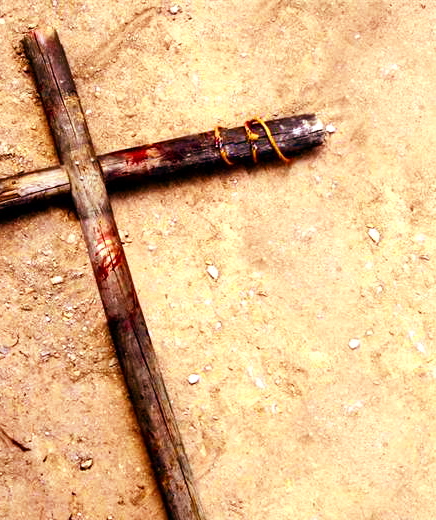
 William Barclay, in his commentary on the Gospel of John, wrote graphically about the horrors of crucifixion—
There was no more terrible death than death by crucifixion. Even the Romans themselves regarded it with a shudder of horror. Cicero declared that it was “the most cruel and horrifying death.” Tacitus said that it was a “despicable death.” It was originally a Persian method of execution. It may have been used because, to the Persians, the earth was sacred, and they wished to avoid defiling it with the body of an evil-doer. So they nailed him to a cross and left him to die there, looking to the vultures and the carrion crows to complete the work. The Carthaginians took over crucifixion from the Persians; and the Romans learned it from the Carthaginians.
Crucifixion was never used as a method of execution in the homeland, but only in the provinces, and there only in the case of slaves. It was unthinkable that a Roman citizen should die such a death. Cicero says: “It is a crime for a Roman citizen to be bound; it is a worse crime for him to be beaten; it is well nigh parricide for him to be killed; what am I to say if he be killed on a cross? A nefarious action such as that is incapable of description by any word, for there is none fit to describe it.” It was that death, the most dreaded in the ancient world, the death of slaves and criminals, that Jesus died.
The routine of crucifixion was always the same. When the case had been heard and the criminal condemned, the judge uttered the fateful sentence: Ibis ad crucem, “You will go to the cross.” The verdict was carried out there and then. The condemned man was placed in the centre of a quaternion, a company of four Roman soldiers. His own cross was placed upon his shoulders. Scourging always preceded crucifixion and it is to be remembered how terrible scourging was. Often the criminal had to be lashed and goaded along the road, to keep him on his feet, as he staggered to the place of crucifixion. Before him walked an officer with a placard on which was written the crime for which he was to die and he was led through as many streets as possible on the way to execution. There was a double reason for that. There was the grim reason that as many as possible should see and take warning from his fate. But there was a merciful reason. The placard was carried before the condemned man and the long route was chosen, so that if anyone could still bear witness in his favor, he might come forward and do so. In such a case, the procession was halted and the case retried. (emphasis added)
Always remember that Jesus willingly went through this for you and me.
Surely He took up our pain
and bore our suffering,
yet we considered Him punished by God,
stricken by Him, and afflicted.
But He was pierced for our transgressions,
He was crushed for our iniquities;
the punishment that brought us peace was on Him,
and by His wounds we are healed. (Isaiah 53:4-5, emphasis added)


 Craig T. Owens
March 16, 2016 at 1:02 pm
[…] seems so extreme (click here to read The Horrors of Crucifixion)! Why would God allow His Son to go through […]
LikeLike
March 28, 2016 at 6:05 am
[…] crucifixion process itself is one of the most gruesome forms of execution man has ever […]
LikeLike
April 8, 2023 at 1:31 pm
[…] The horrific torture of crucifixion […]
LikeLike
April 10, 2023 at 6:01 am
[…] significant blood loss, and would have put His body in shock. Then the strain on His weakened body during crucifixion would have resulted in His body experiencing either pleural effusion or cardiac effusion, which is […]
LikeLike