


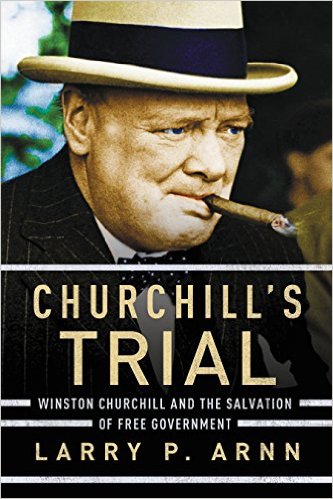
 Winston Churchill waged a lifelong battle against Socialism creeping into a democratic government. He felt it would ultimately undermine the freedoms of individual citizens. In Churchill’s Trial by Larry Arnn, significant space was given to this topic. Here are a few of the most noteworthy quotes on the evils of socialism.
“Human relations are not a contest in which the advantage of some requires the disadvantage of others. That means in turn that government need not have the authority to allocate resources, at least not comprehensively. A government with such power would be in one sense at war with any citizens who have more than others, effectively with all citizens but the few poorest.” —Larry Arnn
“I declare to you, from the bottom of my heart, that no Socialist system can be established without a political police. Many of those who are advocating Socialism or voting Socialist today will be horrified at this idea. That is because they are short-sighted, that is because they do not see where their theories are leading them. No Socialist Government conducting the entire life and industry of the country could afford to allow free, sharp, or violently-worded expressions of public discontent. They would have to fall back on some form of Gestapo, no doubt very humanely directed in the first instance.” —Winston Churchill
“The inherent vice of capitalism is the unequal sharing of blessings. The inherent virtue of socialism is the equal sharing of miseries.” —Winston Churchill
“Churchill’s differences with socialism proceed from this fundamental difference about nature. He thought that the equality for which socialism aimed was unnatural. He thought that it could not be achieved except by suppressing nature, including human nature, which would require the suppression of humans. He thought that because of this fundamental difference, socialism would result in impoverishment in economics, corruption in personal character, and despotism in politics. He thought that by nationalizing these areas of private life in which most human beings do their most urgent and fulfilling tasks, socialism would truncate the lives of ordinary people. For that reason he regarded socialism as dehumanizing.” —Larry Arnn
“A state that attempts to equalize things that are not inherently equal will be at war with human excellence. Some people are in fact wiser, braver, more generous, more skillful, more beautiful, stronger, and more active than others. This does not make them different in their rights, if those rights are defined as the right to employ their ability and gain or lose by their efforts. Both the equality of rights and the differences of human makeup are natural phenomena, and they must be accorded their sway. The attempt to equalize unequal things would, Churchill argued, produce resistance, which in turn would call forth from socialism more vigorous laws. This cycle will continue until all the rights of the people were gone.” —Larry Arnn
“Socialism knows that it can only operate through an agency of bureaucracy under the direction of an autocratic sect.” —Winston Churchill
“If you make 10,000 regulations you destroy all respect for the law.” —Winston Churchill
“Property [means] every thing to which a man may attach a value and have a right; and which leaves to everyone else the like advantage.” —James Madison (emphasis in original)
“If evil systems corrupt good men, it is no less true that base men will dishonor any system, and while no bond of duty more exacting than that of material recompense regulates the relations of man and man, while no motion more lofty and that of self-interest animates the exertions of every class, and no hope beyond the limits of this fleeting world lights the struggle of humanity, the most admirable systems will merely succeed in transferring, under different forms and pretexts, the burden of toil, misery, and injustice from one set of human shoulders to another.” —Winston Churchill
You can read my review of Churchill’s Trial by clicking here.
My first set of quotes from this book can be found by clicking here.


 Craig T. Owens