Adonijah thought he was the obvious heir to the throne so he stated what he believed, “I will be king” (1 Kings 1:5).
On what evidence did Adonijah base his claim?
All of his friends said he would make a great king
His father (the king) had always given him everything he wanted
He was handsome and popular
A couple members of the king’s court supported him
No one had ever told him “no”
While all of this sounded good, Adonijah overlooked some vital points. Like…
…more men backed his brother Solomon to be king than backed him
…his father had the decisive and definitive say in who would be king, and he chose Solomon
…God had chosen Solomon to be king
It’s tempting for us to read the popular sentiment of the moment, or to listen to the cheering voices around us, or even to think that our plans are wise and well thought-out. But this isNOT the right way to make a decision.
Instead, we need to humbly consider three things that are external:
The unbiased, wise counsel of others
The buy-in of key stakeholders
God’s clear “yes”
If these three things are in alignment, you cannot go wrong!
King David was brilliant as a king, and a disaster as a father. One of the things that is very telling is what is not written when his kids mess up. The Bible tells us that David felt strong emotions, but he simply didn’t act on them. In fact, one of the most telling verses of inaction comes when his son Adonijah is trying to put himself on David’s throne—
His father had never interfered with him by asking, “Why do you behave as you do?” (1 Kings 1:6)
It takes courage to interfere with our kids when they are misbehaving.
So why don’t some dads interfere? I can think of a few reasons…
They didn’t have a good relationship with their own father. In David’s case, his father Jesse didn’t think too highly of David. In fact, David was the overlooked, almost-forgotten son (1 Samuel 16:8-11).
They’re too tired. David was so focused on building up Israel’s defenses, and defeating the bad guys, that he had nothing left emotionally and physically to interact with his kids. We need to make it our priority!John wrote: I have no greater joy than knowing my children all walk in the truth (3 John 4). Now that’s a great priority!
Their past sins haunt them. David sinned against Bathsheba (like Amnon did against Tamar); David murdered Uriah (like Adonijah did Amnon). So perhaps he felt like he didn’t have the moral authority to interfere with his sons. But if you read some of the wise sayings in Proverbs 6:20-29 and 7:1-5, they sound like a man who has had experience. Let your hindsight (good or bad) be your kids’ foresight.
They think it’s too late. It’s never too late! Never! Apparently, David learned this lesson in time and taught his son Solomon (read Proverbs 1:1 and 4:3-4). As long as there is breath in your lungs, you should be your kids’ dad!
Dads, will you be courageous enough to lovingly interfere with your kids if they are getting off track?
Will you be courageous enough to make some changes in your schedule so that you can invest the time and energy and creativity necessary to raise them up?
Will you be courageous enough to confess your past sins, and not let them hold you back from speaking into your kids’ lives?
Will you be courageous enough to start today?
Dad, you kids need you to be involved! Be courageous enough to step into their lives.
Listen to the podcast of this post by clicking on the player below, and you can also subscribe on Apple, Spotify, or Audible.
Does success come from hard work, or does it have another origin? We can certainly manufacture success by doing some public relations, some spin, some creative promotion. And from the outside, it can look very successful. Someone may even do such a good job manufacturing their success that they begin to believe their own press releases.
But humanly manufactured success rarely lasts.
Consider the case of a man named Adonijah. He was the heir-apparent in Israel. As the oldest living son of the famed King David, Adonijah was the odds-on favorite to be the next king. And so Adonijah began to manufacture a successful transfer of power for himself. He invited all the right people and ignored those who he knew wouldn’t go along with his plan. He set up everything just the way a prince ascending the throne should have it. His followers joined him for a party and began to raise their glasses in a toast: Long live King Adonijah!
Except God—and King David—had other plans. Just as God directed, David had his son Solomon anointed king. When the few followers that were toasting Adonijah heard this, they all bailed on him and ran away. Even Adonijah recognized that something else can trump manufactured success. Here’s what he said:
“As you know, the kingdom was mine. All Israel looked to me as their king. But things changed, and the kingdom has gone to my brother; for it has come to him from the LORD.” (1 Kings 2:15)
“Success has come to him from the Lord.” God’s success always trumps humanly manufactured success.
Manufactured success leads to pride (the kingdom was mine). And pride over-exaggerates our self-worth and obscures reality (all Israel looked to me as their king). God’s success comes to the humble who recognize His lordship and their place in His Kingdom. God’s success lasts.
Although Adonijah eventually recognized this, he didn’t learn from it. In the next scene, he is again trying to manufacture a way to ascend to the throne. And this time he not only loses his position but his life as well.
Here’s what Jesus says: For whoever exalts himself will be humbled [manufactured success], and whoever humbles himself will be exalted [God’s success].
Listen to the podcast of this post by clicking on the player below, and you can also subscribe on Apple, Spotify, or Audible.
How would you define loyalty? All of the dictionary definitions have to do with faithfulness. It’s almost implied that there is a blindness (at worst), or a dogged persistence (at best), to remain loyal to a person or to an idea. The thinking goes, “If I’m loyal to someone, like it or not, I become their Yes-man.”
But I think…
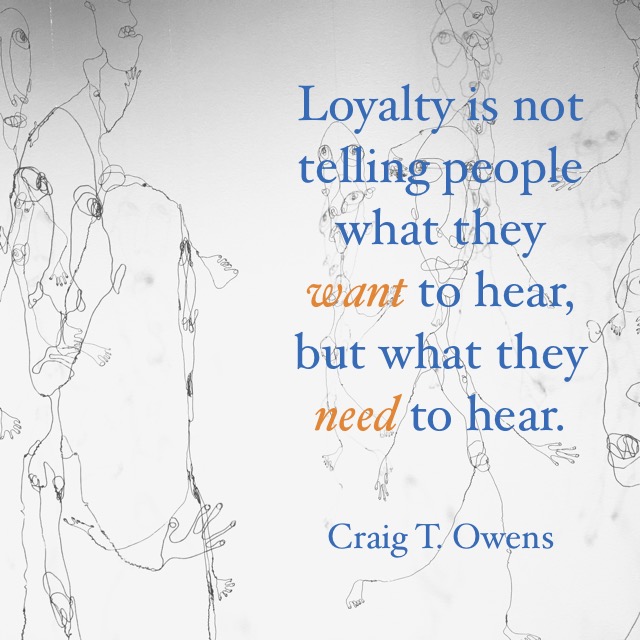
Loyalty is not telling people what they want to hear, but what they need to hear.
For an example, take the prophet Nathan in the Bible. We don’t know how old he is when he steps on the scene, or even where he came from. There isn’t a clue as to his tribal ancestry or even his father’s name.
King David wanted to build a temple for the ark of the covenant of the Lord, and he asked Nathan about this. Nathan immediately said, “Yes!” (kinda reinforces that idea of loyalty = Yes-man, doesn’t it?) But wait! That night, God speaks to Nathan and says, “Tell David he’s not the one to build the temple for Me.” So Nathan returns to David and loyally tells him no.
Later on, David steals another man’s wife and contrives a plan to have that man murdered on the battlefield. David thinks he’s gotten away with it until Nathan, the loyal friend, shows up to confront David with his sin. Nathan didn’t want to see David fail, but he wanted to give him a chance to confess and repent.
Near the end of David’s life, one of David’s sons, Adonijah, wanted to take the throne for himself. Many of the officials in David’s palace jumped on the bandwagon, but loyal Nathan did not. In fact, Nathan even got word to the King about Adonijah’s plans. As a result, David asked Nathan to anoint his son Solomon as king.
During David’s life, Nathan wrote David’s biography. If Nathan was just a mindless Yes-man, he could have easily left out the messy parts of David’s life. But the loyal friend wanted to show future readers that we all mess up, but God forgives and restores us when we repent.
Nathan’s name means the gift God gave or a giver. Both meanings fit this loyal man.
Loyal friends give their friends the gift of life. They don’t let friends go down a destructive path. They don’t join with others when they attack. They remain constant, always-there, friends.
What a blessing to be called a loyal friend! And what an even greater blessing to have “Nathans” in our own lives!
King David is one of the most well-known characters in the Old Testament. Such incredible stories are told about him that his life can be summed up in one phrase that occurs four times in Scripture—The Lord gave David victory everywhere he went (2 Samuel 8:6, 14; 1 Chronicles 18:6, 13).
When David was faced with a challenge or an enemy, he threw himself fully into meeting the enemy head-on, and he was always successful. There is no record of David ever being defeated in battle. If he went out, he won.
Aha, keyword alert—The Lord gave David victory everywhere he WENT.
The only times David was defeated was when he stood still:
• When his son Absalom killed another of David’s sons, Amnon, David didn’t do anything. Even when Absalom returned from exile, David stayed home and didn’t reconcile with his son (2 Samuel 13-15).
• David’s son Adonijah behaved inappropriately and eventually rebelled against David, too. But David “never interfered with him by asking, ‘Why do you behave as you do?’” (1 Kings 1:6).
• David lusted after and then committed adultery with Bathsheba when, “In the spring, at the time when kings go off to war, Joab led out the armed forces. … But David remained in Jerusalem” (1 Chronicles 20:1).
• David angered God by ordering that a census be taken of all of the men eligible for military service in Israel. “So David said to Joab and the commanders of the troops, ‘Go and count…” (1 Chronicles 21:2). In other words, David stayed while others went.
Solomon correctly noted, “The path of life leads upward for the wise to keep him from goingdown to the grave” (Proverbs 15:24). There are only two directions: forward (or up) OR backward (or down). There is no standing still.
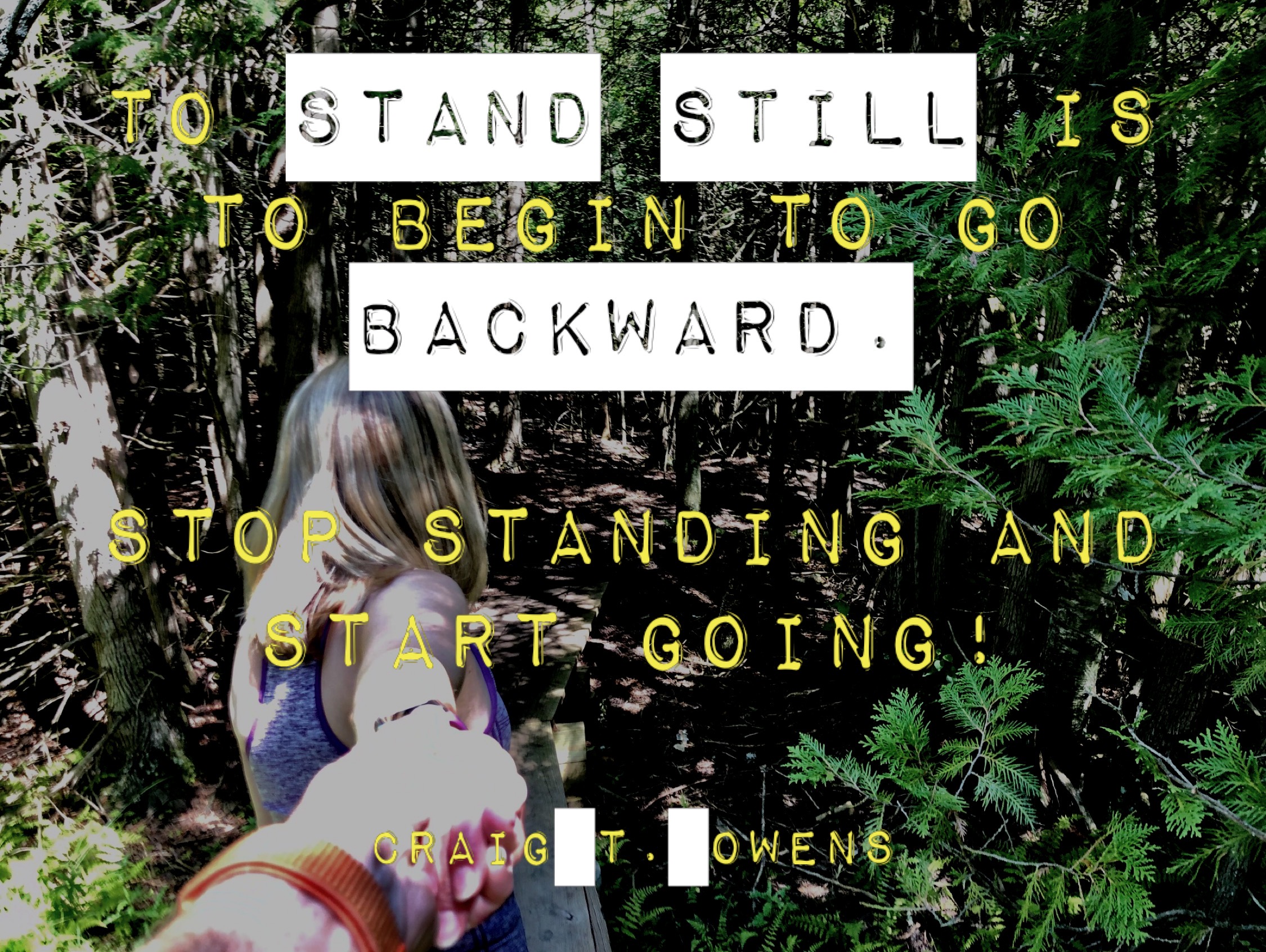
The Lord gave David victory everywhere he WENT, not everywhere he stood still. To stand still is to begin to go backward.
Is there a battle you need to fight? Is there a challenge you’ve been avoiding? Is there something you need to complete? Are you waiting for something to happen? Are you content just to stand still?
Stop standing still and start going! If you are following God, He will give you victory everywhere you go.



 Adonijah thought he was the obvious heir to the throne so he stated what he believed, “I will be king” (1 Kings 1:5).



 Craig T. Owens