


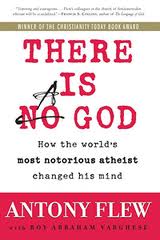
 As I said in my book review of Anthony Flew’s There Is A God, the real value of this book is in the arguments which contributed to Flew’s shift from atheism to theism. You can read my full book review by clicking here.
Frankly, it’s hard to share a lot of the quotes because the context of the full argument would be lacking, but I’m going to attempt to share some of them in multiple posts. To start with, below are some of the direct quotes from Anthony Flew.
“I have said in some of my later atheist writings that I reached the conclusion about the nonexistence of God much too quickly, much too easily, and for what later seemed to me the wrong reasons. I reconsidered this negative conclusion at length and often, but for nearly seventy years thereafter I never found the grounds sufficient to warrant any fundamental reversal. One of those early reasons for my conversion to atheism was the problem of evil.”
“The presumption of atheism can be justified by the inescapable demand for grounds. To believe there is a God, we have to have good grounds for the belief. But if no such grounds are provided, there exists no sufficient reason for believing in God, and the only reasonable position is to be a negative atheist or an agnostic (by negative atheist, I meant ‘a-theist,’ parallel to such words as atypical and amoral). … This argument garnered many and varied responses. Writing as an agnostic, the English philosopher Anthony Kenny maintained that there may be a presumption for agnosticism, but not for positive or negative atheism. He suggested that it takes more effort to show that you know something than that you do not (this includes even the claim that the concept of God is not coherent). But he said this does not let agnostics off the hook; a candidate for an examination may be able to justify the claim that he or she does not know the answer to one of the questions, but this does not enable the person to pass the examination. … By far, the heaviest challenge to the argument came from America. The modal logician Alvin Plantinga introduced the idea that theism is a properly basic belief. He asserted that belief in God is similar to belief in other basic truths, such as belief in other minds or perception (seeing a tree) or memory (belief in the past). In all these instances, you trust your cognitive faculties, although you cannot prove the truth of the belief in question. Similarly, people take certain propositions (e.g., the existence of the world) as basic and others as derivative from these basic propositions. Believers, it is argued, take the existence of God as a basic proposition.”
“If there is an infinite series of books about geometry that owe their pattern to copying from earlier books, we still do not have an adequate answer as to why the book is the way it is (e.g., it is about geometry) or why there is a book at all. The entire series needs an explanation.”
“Science qua science cannot furnish an argument for God’s existence. But the three items of evidence we have considered in this volume—the laws of nature, life with its teleological organization, and the existence of the universe—can only be explained in the light of an Intelligence that explains both its own existence and that of the world.”
“My discovery of the Divine has been a pilgrimage of reason and not of faith.”
Check back soon for some additional quotes from this thought-provoking book.


 Craig T. Owens