


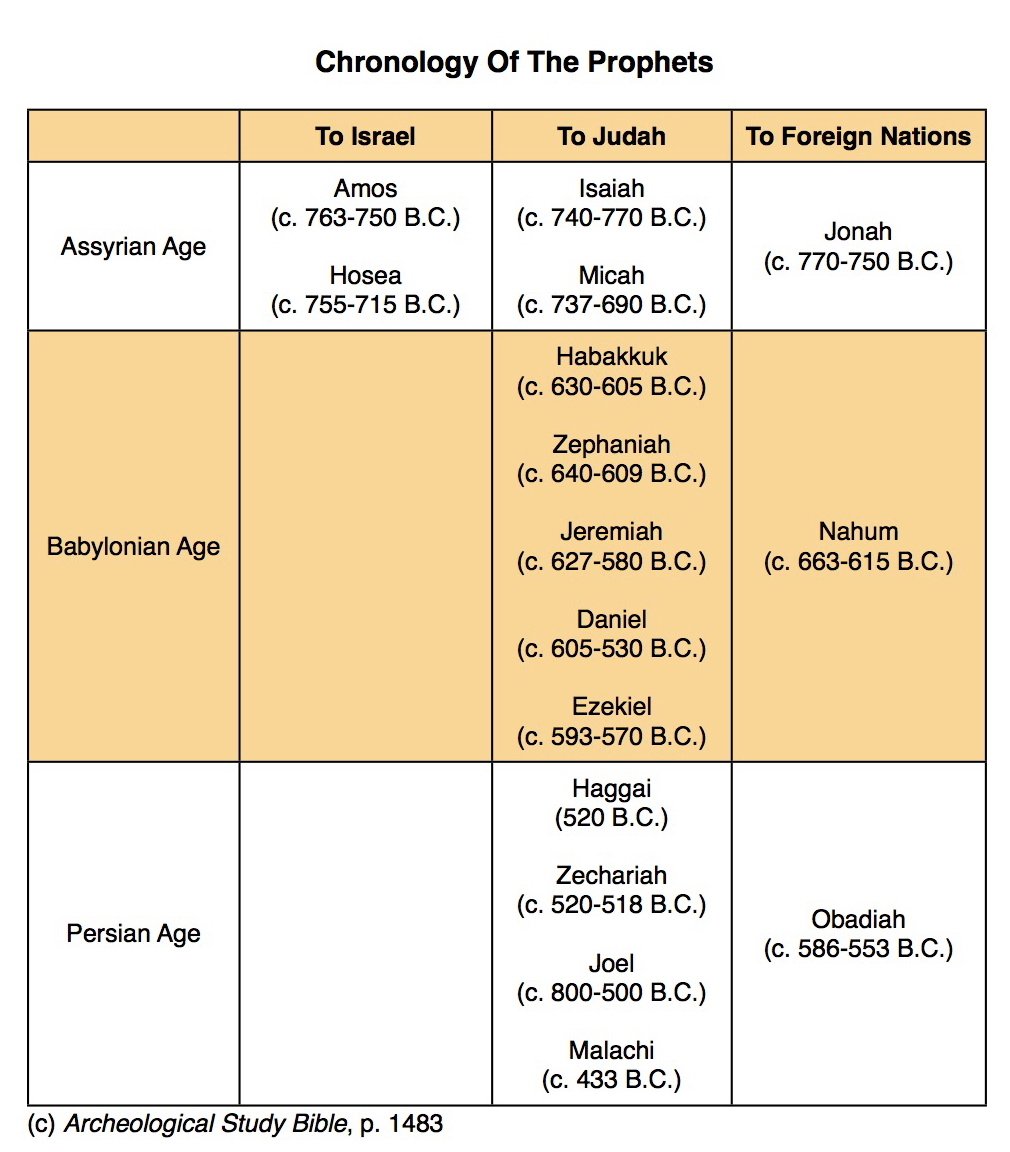
 I am throughly enjoying my reading through The Archeological Study Bible. I am reading through the Scripture in chronological order. You can download a chart I produced of the kings and prophets of Israel and Judah by clicking here.
The chart in this post was produced by the editors of The Archeological Study Bible, which I have simply reproduced here. You can click on the picture for a larger view, or you can download a PDF version by clicking here → Chronology Of The Prophets ←
My prayer is that resources like this will aid your own personal Bible reading!


 Craig T. Owens
November 22, 2016 at 8:39 pm
I like your chart, but am wondering if the years for Isaiah should read 740 to 670 rather than 740 to 770.
Thanks for all your work on this.
LikeLike
November 23, 2016 at 6:32 am
Good catch, Harlan! I will get that updated.
LikeLike
April 11, 2018 at 6:04 am
[…] Isaiah had the same message for four kings: […]
LikeLike
July 8, 2018 at 3:09 pm
Wonderful references! Thank you.
LikeLiked by 1 person
December 12, 2018 at 11:19 am
I find it hard to believe that Joel lived for 300 years. Are you sure those dates for him are accurate? And if so, why did he not prophesy during the Assyrian and Babylonian ages? It seems odd that he’d remain silent until the Persians arrived.
LikeLike
December 14, 2018 at 6:07 pm
Pamela, that is an excellent observation! In the Archeological Study Bible, the editors have this article on the date of Joel’s writing:
“The book of Joel itself gives no indication of its date of authorship. This is unusual in the Old Testament prophetic literature; most prophets indicated that they preached during the reigns of certain kings (e.g., Hosea 1:1; Haggai 1:1) or provided other chronological indicators (Amos 1:1). The dates suggested for Joel range from the ninth century B.C. (making him the earliest of the writing prophets) to the late postexilic period (making him one of the latest). The following arguments are often raised in the discussion:
* Joel is the second of the minor prophets, and thus the book is early, since they are roughly presented in chronological order. But there are exceptions to this rule: Obadiah, for example, almost certainly was written later than Micah, and Hosea later than Amos.
* No kings are mentioned, and therefore the book is postexilic. On the other hand, postexilic prophets sometimes dated their books by Persian kings (Haggai 1:1; Zechariah 1:1). Thus, the non-mention of any king does not imply anything in particular about the book’s date.
* Joel does mention priests and elders, and therefore the book was written when the nation was governed by these groups rather than by a king, making the book postexilic. However, the elders are mentioned only in a context of calling for ritual lamentation (2:15–17). They are not said to have been in a governing position, and the reference may in fact have been literally to a group of elderly men (1:2). Again, nothing here helps us to date the book.
* Joel never alludes in any way to the northern kingdom (usually called Israel or Samaria), suggesting that the northern kingdom may no longer have existed and that the book was thus written after the fall of Samaria (722 B.C.)
* Jerusalem had walls (2:7–9). Thus, the book was written either before its fall (586 B.C.) or late in the postexilic period, after the walls had been restored.
* Worship was carried out at the temple (2:15–17), indicating that the book was written either before its destruction or after its restoration.
* All who lived in the land could gather in Jerusalem (1:14). This suggests that the population of the community was relatively small, as in the late preexilic or the postexilic period.
A few other fine points regarding the language and circumstances of Joel are debated but have produced no consensus. All in all, the above considerations speak against a date that was very early, very late or during the exile. Apparently the northern kingdom no longer existed, but the temple was functioning and Jerusalem’s walls were intact. A seventh-century B.C. date seems reasonable, but the fact remains that the book itself does not tell us when it was written.”
Hope that helps!
LikeLike
May 7, 2022 at 10:13 pm
Thank you for such helpful comments regarding the dating of the writings of Joel. Thank you also very much for the very helpful charts of the kings and prophets. I am currently reading the excellent “The Daily Bilbe: in Chronological Order NIV” arranged by F. LaGard Smith. I have your charts sitting alongside of “The Daily Bible” as I read. It has proven such a helpful guide to keep the complexity of relationships between the nations, the kings, the prophets and the events in historical juxtaposition.
LikeLiked by 1 person
May 7, 2022 at 10:16 pm
Thank you, Geoffrey, for letting me know. I’m so glad you’re finding it helpful!
LikeLike